Emerging Trends in Digital Payments and Banking
Nathan Cole September 19, 2025
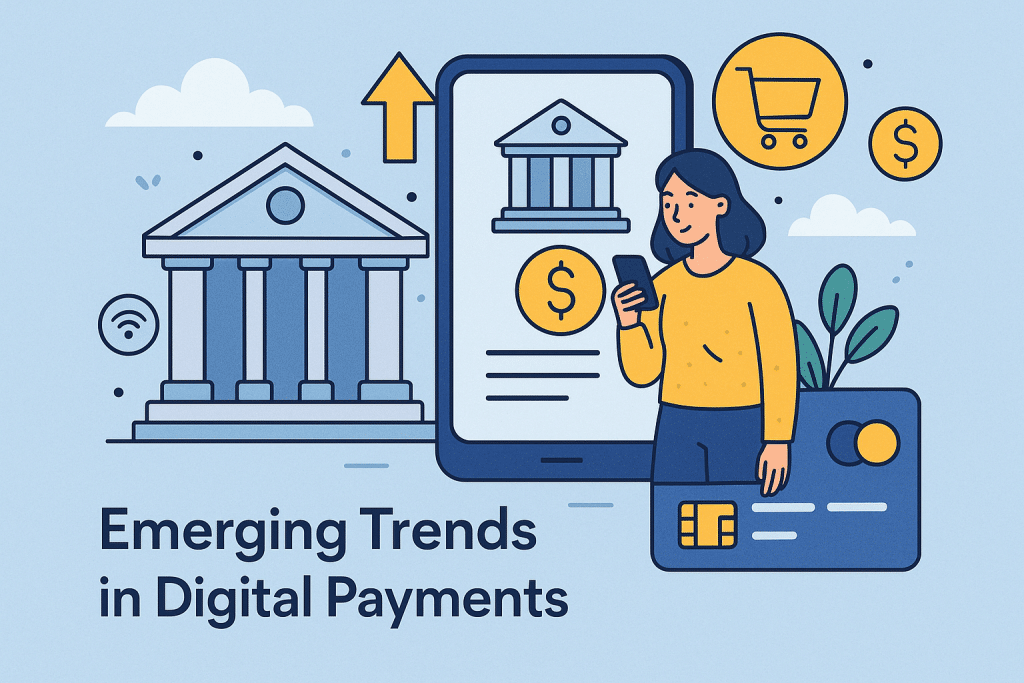
In 2025, invisible payments and BNPL regulation are two of the most disruptive forces in digital payments and banking. As consumers demand seamless experiences and regulators push for protections, banks and fintechs must adapt or risk falling behind.
What are invisible payments?
Invisible payments are transactions that happen without the user having to manually initiate them at checkout. They are embedded in everyday experiences – such as auto-billing, payments within apps or IoT devices, voice-activated payments, or payments embedded in content platforms or social media.
Key features:
- Low friction: less tapping, less entering details.
- Often background or trigger-based (e.g. pay when you finish a ride, when you consume a service).
- Embedded in ecosystems: social media, games, video, voice assistants.
- Require highly reliable security (think behavior monitoring, fraud detection), and transparent communication so users know what’s being charged.
According to a recent report, embedded and invisible payments reduce friction and align very well with mobile-first lifestyles. But there are trade-offs: loss of clarity in spending, possible overuse, or weaker awareness of what’s being charged when payments are “silent.”
Why BNPL regulation is suddenly in focus
“Buy Now, Pay Later” (BNPL) has exploded in popularity. It offers short-term, often interest-free, installment plans at point of sale. Consumers like it because it spreads cost; merchants like it because it increases conversion rates.
However, regulators and credit agencies are increasingly concerned about:
- Consumer risk: people taking on more debt than they realize, having overlapping BNPL obligations.
- Transparency: lack of clarity in disclosures, fees, policy differences.
- Credit scoring and credit reporting: previously many BNPL products did not affect credit scores; this is changing. For example, FICO is incorporating BNPL data into credit scoring beginning in late 2025.
Regulatory developments
- In the UK, the Financial Conduct Authority (FCA) proposed that even small BNPL loans (below £50) be subject to affordability checks.
- In New York state, a BNPL Act has been enacted to bring licensing and consumer protections to BNPL providers.
- EU’s revised Consumer Credit Directive will bring many BNPL providers and large e-commerce platforms under regulatory oversight by 2026.
Biometric security & fraud prevention: keeping pace with ease
Invisible payments and BNPL growth both increase the need for robust security. Biometric authentication (fingerprint, face recognition, voice) and behavioral biometrics are emerging as mainstays for verifying identity and preventing fraud.
Key developments:
- Behavioral biometrics (e.g. patterns of typing, gait, device usage) are being deployed to detect unusual behavior in real time.
- Increased use of AI / ML to monitor transaction risk, flag anomalies (e.g. location discrepancies, velocity checks) for invisible payments.
- Stronger regulatory pressure to meet data protection standards (GDPR, global equivalents) when dealing with biometric and personal data.
How banks, fintechs and consumers can navigate this changing landscape
As invisible payments and BNPL regulation reshape finance, both institutions and individuals must adapt. Success will depend on transparency, security, compliance, and informed decision-making.
For Banks & Fintechs
- Make payments visible: Provide clear histories and real-time push alerts so customers understand every charge. Transparency reduces disputes and builds loyalty (Thomas & Tian 2021).
- Strengthen defenses: Combine biometrics, device recognition, and AI-driven fraud monitoring. Smarter authentication prevents abuse while keeping user experience smooth.
- Get ahead of regulation: Regulators are tightening BNPL rules—licensing, affordability checks, and credit reporting will soon be non-negotiable. Institutions that prepare early avoid costly penalties.
- Empower consumers: Allow easy opt-outs, spending limits, and alerts. Giving users control creates trust in “invisible” transactions.
For Consumers
- Stay on top of commitments: Multiple BNPL purchases can silently add up—review statements regularly.
- Watch your credit: On-time BNPL repayments can improve scores, while missed ones now leave lasting marks (Gulddal 2020).
- Pick transparent providers: Favor companies that clearly display terms and fees. A reputable service is the best protection against hidden costs.
Risks and challenges to watch
Even with strong benefits, there are pitfalls to consider:
Over-spending & debt
Invisible payments feel effortless, which makes overspending easy. When users stack multiple BNPL plans, repayments can snowball into unmanageable debt.
Privacy & security
These systems depend on biometrics and behavioral data. Unlike passwords, stolen biometrics cannot be changed, making breaches far more damaging.
Regulatory complexity
Rules differ across markets. Some countries impose strict credit and data protections, others almost none. This patchwork raises compliance risks, especially for global providers.
Trust & transparency
If users feel misled by hidden fees or unclear repayment terms, backlash can be swift. Without transparency, adoption may stall and reputations can suffer.
Looking ahead: What’s coming in 2026 and beyond
BNPL will soon be regulated almost everywhere. Governments are moving to enforce affordability checks, mandatory credit reporting, and licensing frameworks to prevent overspending. For consumers, this means more protection; for providers, compliance will become a key trust factor rather than a competitive burden.
Invisible payments will continue spreading across daily life. Cars may automatically pay for tolls, charging, or drive-through meals. Smart homes will handle recurring bills, while wearables quietly settle transit fares or subscriptions. In this new reality, “paying” fades into the background, making convenience the default expectation.
Security will also transform. Biometrics like face, fingerprint, and voice ID will be standard for sensitive transactions, while continuous behavioral tracking reduces fraud. At the same time, privacy-preserving tools—like decentralized IDs and zero-knowledge proofs—will allow users to verify themselves without oversharing personal data, balancing security with trust.
Finally, deeper integration across banks, regulators, and providers will reshape the financial ecosystem. Expect wider use of APIs, standardized frameworks for embedded payments, and secure data sharing practices. Together, these changes point toward a seamless, borderless system where transactions are instant, invisible, and more secure than ever.
Conclusion
Invisible payments and BNPL regulation are two sides of the same evolution in digital payments and banking: consumers want payment to be seamless and effortless, but that ease must be balanced with protection, transparency, and responsible use. For banks and fintechs, success in 2025 will come from leaning into innovation while building trust and regulatory compliance. For consumers, staying informed and cautious will be critical.
References
- World Bank. (2022) Digital financial services: resilience and innovation during COVID-19. Available at: https://www.worldbank.org/en/news/feature/2022/04/14 (Accessed: 19 September 2025).
- McKinsey & Company. (2023) The future of payments 2023: The next chapter in global payments. Available at: https://www.mckinsey.com/industries/ (Accessed: 19 September 2025).
- Statista. (2024) Digital payments worldwide – statistics and facts. Available at: https://www.statista.com/topics/ (Accessed: 19 September 2025).

 Real Estate Strategies That Maximize Investment Returns