Emerging Trends in Digital Marketing
Nathan Cole September 29, 2025
In an era where users expect answers—not just links—Answer Engine Optimization (AEO) is quietly becoming the new frontier in digital marketing. In this article, we explain what AEO is, why it matters now, and how marketers can adapt to this shift.
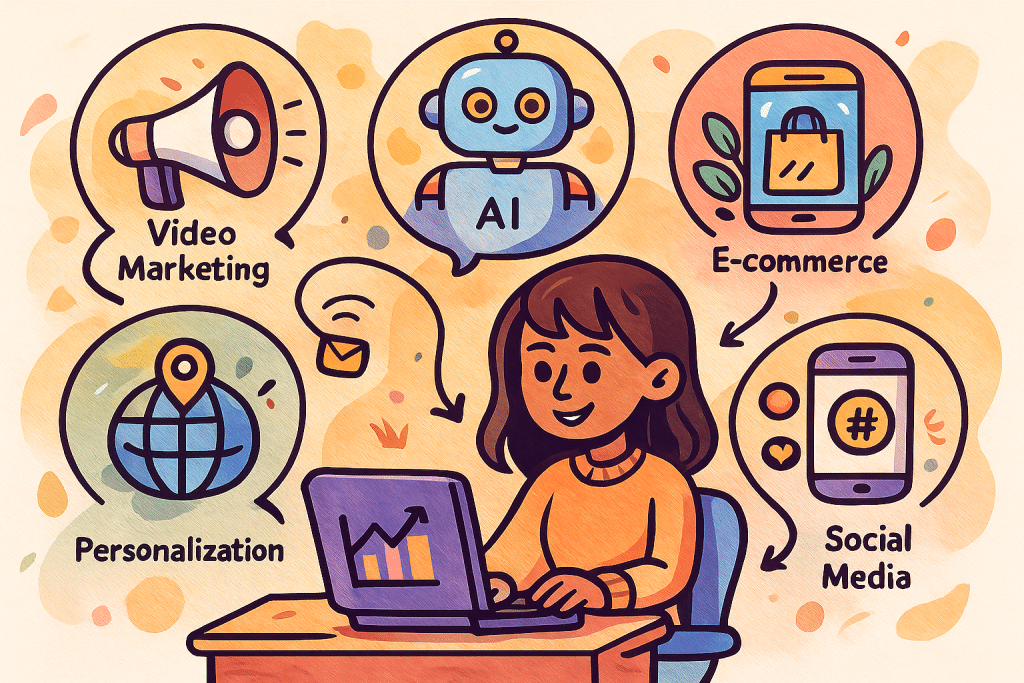
Why AEO Is Emerging Now
From Search Engines to Answer Engines
Traditional SEO is built around ranking pages in response to keyword queries. But with the rise of AI chatbots and conversational models (like ChatGPT, Bard, and Google’s new generative answer features), more users are getting their answers directly from AI systems, rather than clicking through to websites. As a result, the game is shifting: it’s no longer enough to optimize for search engines—brands must optimize for answer generation. AEO is the practice of tailoring content so that it is more likely to be selected, cited, or surfaced by AI-driven answer systems.
Business Insider recently noted that AEO is “replacing traditional SEO” as chatbots and generative engines become primary sources of information. Meanwhile, a related concept, generative engine optimization (GEO), has emerged to help content creators adapt to the AI answer paradigm.
AI Search & Zero-Click Answers
Google and other platforms are increasingly embedding AI-generated summaries or overviews on the search results page, sometimes removing the need to click through entirely. That shift generates more “zero-click” queries, where users get the answer directly in the search interface. Content that is well-suited to these AI summaries thus stands to gain visibility—even if it doesn’t rank first in the old sense.
This means visibility doesn’t always equate to page rank anymore: it’s about being selected by the AI system as the best answer.
Widespread AI Adoption in Marketing
The technological and market environment is primed for this shift:
- McKinsey reports that in 2024, 78% of organizations used AI in at least one business function, and marketing is one of the top areas of adoption.
- In 2024, 69.1% of marketers said they incorporate AI into their marketing strategies, up from ~61.4% the prior year.
- Marketing commentary highlights that AI (especially generative AI) is now central to personalization, automation, content generation, and performance campaigns.
With AI embedded more deeply in marketing stacks, it’s natural that optimization discipline evolves accordingly.
What AEO Entails: Core Principles & Tactics
If SEO optimizes for keywords and links, AEO optimizes for answerability, trust, and alignment with AI models’ criteria. Below are the main principles and tactics for succeeding with AEO.
1. Structure for Answer Clarity
- Use question-and-answer formats in your content. If you write “What is X?” and then provide a concise, authoritative answer, you’re signaling AI systems what to use.
- Place succinct definitions or summaries near the top of pages (e.g. first 100–150 words), so AI can more easily extract the “best answer.”
- Use lists, bullet points, and tables: they help AI parse structured information.
2. Cover Topic Clusters, Not Just Keywords
AI answers tend to favor content that addresses related sub-questions and builds a richer knowledge graph around a topic. Rather than treating each keyword in isolation, build a cluster covering variants, follow-ups, alternative questions, and context.
3. Use Authoritative Signals & Trustworthiness
- Use data, evidence, statistics, citations, and references. AI systems often prefer content that cites credible external sources.
- Use consistent author bylines, with credentials or domain expertise.
- Encourage original research or unique data (rather than just aggregating from other sites).
4. Semantic Depth Over Exact Matching
Since AI uses embeddings and semantic understanding, exact keyword matching matters less than covering related concepts and synonyms. Use natural language that mirrors how people ask questions.
5. Monitor AI Visibility & Mentions
Platforms like Otterly.ai help brands track their presence in AI-generated results—i.e., whether their content is being cited by LLMs. Use such tools to see which pieces of content are performing well in AI answer spaces and optimize others accordingly.
6. Balance Answerability with Click Incentive
If the AI answer is too comprehensive, users may never click through. One tactic is to provide a compelling summary (that the AI may use) but leave deeper insights or examples just beyond in the article, so those who want more must engage further.
How AEO Changes the Digital Marketing Funnel
AEO reshapes the typical funnel stages:
- Awareness: Instead of capturing visibility in search results, brands must become the answer for early questions.
- Consideration: AI can compare and contrast options, so content must emphasize unique differentiators, comparisons, pros/cons.
- Conversion: Use CTAs, structured data, rich snippets, and conversational prompts to guide next steps.
Also, because AI may answer first and then offer a “read more” link, brands that secure that snippet positioning effectively get both visibility and traffic. The goal shifts from ranking to selection.
Practical Steps: How to Begin Adapting to AEO (Step-by-Step)
Below is a 6-step roadmap you (or your marketing team) can use to begin integrating AEO thinking into your strategy:
| Step | What to Do | Why It Helps |
|---|---|---|
| 1. Audit top content | Identify pages that already answer user questions. | These are prime candidates to adjust for AEO. |
| 2. Expand related question coverage | Use keyword tools, People Also Ask, forum queries, chat logs to gather auxiliary questions. | Broadens your topic cluster. |
| 3. Add concise summary blocks | Insert a “TL;DR” or “Key Takeaway” in <100 words at the top. | Makes extraction easier for AI models. |
| 4. Improve authority signals | Add data, references, author info, external links to reputable sources. | Boosts trust signals. |
| 5. Use structured markup and schema | Mark definitions, FAQs, comparisons via schema where possible. | Helps machines understand content structure. |
| 6. Track AI visibility & evolve | Use tools (like Otterly, others) to monitor where your pages get cited by AI | Allows you to iterate and improve. |
Challenges, Risks & Ethical Considerations
Risk of Oversimplification
Because AI answers favor brevity and clarity, content may get oversimplified or lose nuance. Be careful not to let complexity or subtlety disappear entirely.
AI-Generated Content Wrestling
As more marketers and creators use AI to generate content, there’s a risk of saturation, low-quality output, and “AI slop” (content that lacks depth or authenticity). You must balance automation with critical editing and originality.
Trust, Accuracy, and Misinformation
If your content is poor or outdated, AI might still select it and amplify misinformation. Maintaining editorial standards, fact-checking, and timestamping becomes more critical. Researchers warn about AI-fabricated disinformation flooding marketing and undermining trust.
Platform Dependence & Algorithm Opacity
You’re essentially optimizing for systems you don’t control. AI models change, ranking logic changes, and the criteria for what gets selected may shift rapidly. That means continuous adaptation is required.
When (and When Not) to Prioritize AEO
AEO is especially valuable when:
- Your audience frequently uses AI chat / conversational search (tech-savvy users).
- You operate in knowledge-heavy domains (e.g. finance, health, education, software).
- You have resources to build authoritative, high-quality content (vs. thin content farms).
It may be less effective (or riskier) when:
- Content is extremely local or hyper-niche (AI may not surface it).
- You lack the capability to maintain high content standards.
- The domain requires regulated or heavily curated information (e.g. medical, legal)—mistakes can be very costly.
Outlook: What AEO Means for the Future of Digital Marketing
Evolving Content Models
In coming years, content creation will evolve toward “answerable units”—snippets, microarticles, FAQs, dialogues—rather than monolithic longform only.
Search as Conversation
Search will become more conversational. Brands may participate in multi-turn Q&A experiences rather than just publishing static pages.
New Metrics & KPIs
Traditional metrics like ranking position may decline in relevance. Instead, brands will monitor metrics like:
- AI answer “share” (how often their content is cited)
- Click-through from AI answer interfaces
- Engagement on AI-displayed summaries
Integration with Voice & Multimodal Interfaces
Voice assistants and AR/VR interfaces will consume answers. AEO will extend into voice (Alexa, Siri) and multimodal interfaces where answers must be spoken, shown, or contextual. Marketers will need to think not just textually but holistically across modalities.
Conclusion
AEO is not a fad—it marks a structural shift in how information is served and consumed in a world dominated by generative AI. Marketers who cling solely to traditional SEO will risk invisibility in the next wave of discovery. Instead, by adopting AEO strategies—prioritizing answer clarity, authority, semantic depth, and monitoring AI visibility—you can position your content as the answer in a new era. The sooner your team begins experimenting, the better your chances of staying ahead.
References
- Chaffey, D. (2023) Top 10 Digital Marketing Trends for 2023. Smart Insights. Available at: https://www.smartinsights.com (Accessed: 28 September 2025).
- HubSpot (2024) The Future of Digital Marketing: Key Trends to Watch. HubSpot Blog. Available at: https://blog.hubspot.com (Accessed: 28 September 2025).
- Statista (2023) Global Digital Advertising Spending from 2019 to 2028. Statista. Available at: https://www.statista.com (Accessed: 28 September 2025).

 Nutrition Tips That Boost Mental Clarity