Travel Experiences That Inspire Creativity and Learning
Adrian Park September 30, 2025
In 2025, travelers are turning trips into laboratories for creativity and growth. Between hotel artist-residencies, narrative-driven itineraries, and immersive learning programs, the concept of a “vacation” is evolving. This article explores the how and why of this shift, and guides you in tapping into it.
Why Travel Is Becoming a Platform for Creative Learning
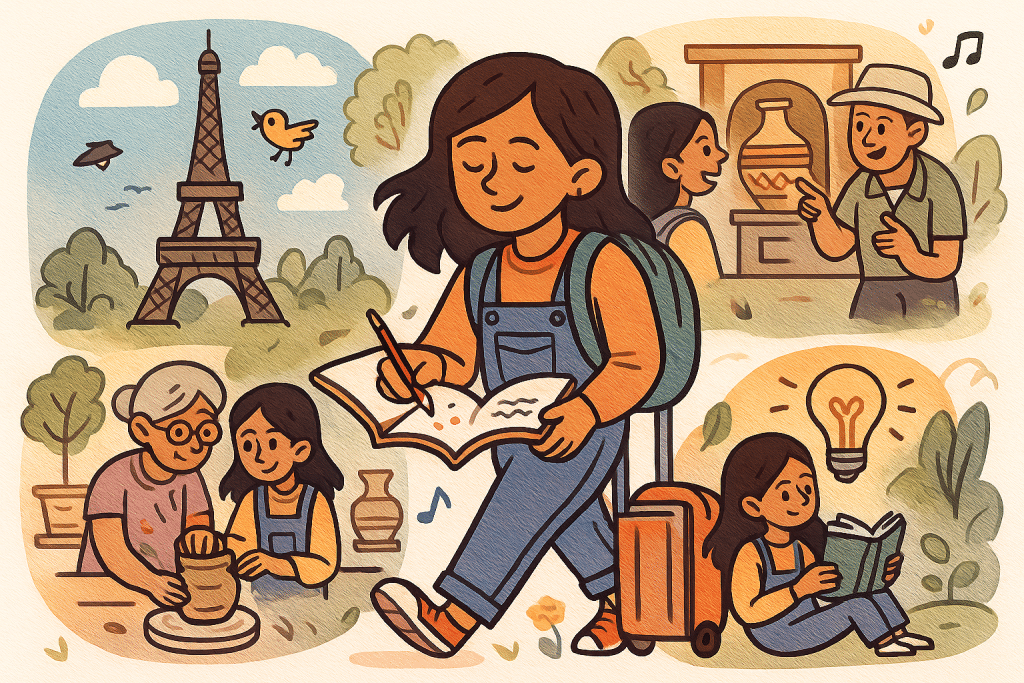
Traditional sightseeing is no longer enough. Many modern travelers seek experiences that change their perspective, teach new skills, or spark new ideas. This evolution is part of a broader tilt toward experiential travel, where immersion, participation, and personal growth matter more than ticking off landmarks.
In 2025, travel trends point strongly in this direction:
- Experience-first bookings: The fastest-growing categories are interactive, hands-on experiences — cooking classes, artisan workshops, cultural exchanges — rather than passive tours.
- Immersive & sustainable stays: Travelers want meaning. Hotels and properties are embedding creativity, art, and local culture into the stay itself (not just as add-ons).
- Artist residencies in hotels: Hotels are converting suites or studios to host working artists, designers, and creatives — giving guests access to live creative processes.
These shifts respond to a deeper need: travelers no longer want to be passive spectators; they want agency, transformation, and new skills. That’s where creative travel learning becomes a compelling framework.
Trend Spotlight: Hotel-Based Artist Residencies
One of the most visible manifestations of creative travel learning is the rise of artist residencies within hospitality settings.
What are hotel artist residencies?
These are arrangements where hotels host artists, writers, designers, or creative professionals for weeks or months. The resident may produce work on site, lead guest workshops, or simply act as a cultural ambassador. Meanwhile, guests can observe, attend open studios, or even collaborate.
This trend is gaining traction. According to Business Traveller, many hotels are now inviting creative residents as part of a repositioning that blurs lodging and cultural hub. Forbes further describes how art is becoming a core part of guest experience design — from curated installations to live performances.
Why it matters for learning travelers
- Access to working creatives: Guests can see the creative process up close — attend studio talks, get feedback, or even co-create.
- Local context & inspiration: Residents often engage with local crafts, traditions, or social issues, giving guests deeper cultural insight.
- Skill transfer: Workshops or “residency open days” allow guests to pick up new techniques (painting, printmaking, digital art) guided by active practitioners.
- Authentic storytelling: The presence of a working artist changes how guests perceive a place — it becomes a living canvas, not a backdrop.
Across the globe, creative residencies are reinterpreting the function of hotels from passive accommodation to creative salons.
Narrative-Driven Itineraries: Travel as Story, Not Just Route
Another emerging trend linked to creative travel learning is narrative-driven travel planning — designing a trip as a storyline, rather than a list of attractions.
What is narrative-driven itinerary planning?
A recent academic model called Narrative Guide generates travel scripts that align attractions, transitions, and storytelling arcs. Rather than just plugging in places, the model weaves a theme or character journey across your trip.
From a practical perspective, it means:
- An itinerary has a beginning, middle, and end — not just Day 1, Day 2, Day 3.
- Each site is a “scene” contributing to a broader narrative (e.g., growth, conflict, contrast).
- The transitions between places are meaningful — you don’t just teleport; the journey itself carries narrative weight.
Why narrative travel enhances creative learning
- Cognitive engagement: You interpret and internalize each stop rather than consuming passively.
- Memory & insight: You’re more likely to remember and reflect on a trip when it follows a narrative arc.
- Creative response: You may sketch, journal, map, or write around the story as you travel — making the trip itself generative.
- Skill in storytelling: You sharpen your ability to see structure, metaphor, and context — useful for writers, designers, educators.
Narrative itineraries pair especially well with creative residencies or learning-focused stays: the trip itself becomes your canvas.
Creative Travel Learning in Action: Forms That Work
To make creative travel learning more concrete, here are key formats you can explore or design into your trips:
- Short residencies and workshops
- Week-long art or craft residencies in rural settings (e.g., pottery in Andalusia, textile workshops in India).
- Creative bootcamps that mix local mentors, field visits, and studio time.
- Learning through practice
- Culinary travel with apprenticeship-style cooking courses in the host’s kitchen.
- Film or photography travel, where each day includes editing, critique sessions, or thematic assignments.
- Local mentorship & craft immersion
- Staying with artisans or cultural custodians to learn hands-on from local masters (e.g., weaving cooperatives, woodcarvers).
- Participatory cultural projects — e.g., helping with a mural, community storytelling, or eco-art installations.
- Hybrid travel + remote projects
- Travel stints interleaved with remote creative work.
- Use narrative itineraries that allow for reflection phases, writing, or virtual collaboration as you move.
- Slow creativity travel
- Extend stays to let ideas marinate. Instead of hopping cities every night, anchor in one creative locale for days or weeks.
- Combine with nature, walks, sketching, and unstructured time.
The key is not just seeing but doing, making, and reflecting.
How to Plan a Creative Travel Learning Journey
Here’s a step-by-step guide you can adapt to your interests, whether you’re a visual artist, writer, designer, or curious learner:
1: Define your creative goal
Ask yourself:
- Do I want to generate new work, explore a medium, or just be inspired?
- How much structure do I prefer (intensive workshop vs open time)?
- What constraints — budget, mobility, time — must I observe?
2: Research residencies, creative stays, and narrative itineraries
- Use networks like Res Artis, TransArtists, or open calls published for 2025 residencies.
- Look for hospitality brands already experimenting with in-house residencies.
- Consider narrative planning tools or local guides who can co-design story arcs.
3: Match location to inspiration and accessibility
Prefer places that:
- Offer both creative stimulus and logistical support.
- Support maker communities or local culture.
- Are less trodden than mainstream hotspots (so your creative voice can breathe).
4: Blend structure and freedom
- Schedule core anchor activities (studio time, workshops) but leave buffer days for wandering, experimentation, or reflection.
- Use your narrative arc to guide each day’s intent (e.g. “contrast,” “tension,” “resolution”).
- Document along the way — journal, sketch, photo, or audio record.
5: Engage with community
- Seek collaborations or critiques with local creators.
- Host an open studio or mini show for guests or neighbors.
- Use the residency flow to contribute — teach a micro class, help with a communal project.
6: Reflect & iterate
- At trip’s midpoint and end, pause to review evolving ideas, shifts, surprises.
- Map your itinerary narrative against your internal creative arc — adjust if needed.
- Archive or present an outcome: a small exhibit, a zine, a video, or a blog.
Case Studies & Examples
1. Palazzo Monti, Italy (design residencies)
Shakti Design Residence (India/Italy) combines contemporary design and traditional craft through co-mentorship. Selected designers spend a month between Jaipur and New Delhi working with artisans under mentorship.
This model blends cross-cultural collaboration and craft-based learning — an ideal template for creative travel learning.
2. Hotels with artist-in-residence programs
Hotels are turning rooms into creative incubators. Some examples:
- A New York hotel hosts digital artists in a rooftop suite, inviting guests to view work in progress.
- In Japan, a rural ryokan invites writers in residence, with guests allowed to sit in on readings or mini-classes.
- In Indonesia, boutique resorts host in-house textile artists who teach weaving to interested guests.
These programs illustrate how hospitality + creative practice can coexist in a stay.
3. Narrative-guided city trip
Imagine a week in Kyoto built on a narrative arc: “Seeds of Silence → Showers of Memory → Blossoms of Renewal.” Each day’s site (temple gardens, teahouses, rural villages) aligns with a theme. You carry a field journal, sketch certain hours, and close with a creative prompt at day’s end. That kind of trip is less about “seeing all of Kyoto” and more about feeling and responding to it.
The narrative itinerary model shows how the journey becomes part of your creative medium.
Challenges & Tips to Make It Work
Logistical & financial constraints
Residencies and creative stays can be expensive or competitive. Mitigate by:
- Applying early to funded or subsidized residencies (e.g. scholarships in Italy)
- Seeking collaborative dual roles (you teach something in return).
- Blending with conventional lodging — part of the time in a residency, part in standard guesthouses.
Balancing travel fatigue and creative flow
Travel is tiring. Too many cities too fast kill creativity. Combat this by:
- Anchoring creative stays in one or two locations, using travel days as transitions, not daily hops.
- Prioritizing rest days or unstructured time.
- Building in buffer days for detoxing, reflection, or catching up.
Aligning expectations vs reality
A workshop might not yield a masterpiece — it may yield a spark. Go in open. Use documentation (photos, notes) to track incremental growth.
Digital tools and narrative aids
- Use narrative itinerary tools (or even LLM-assisted planners) to script creative arcs.
- Carry a portable sketchbook, field recorder, or digital notebook to capture ideas in real time.
- Use mapping or journaling apps to record how your emotional/creative tone evolves.
Why This Trend Matters for the Future of Travel + Learning
- It shifts travel from “consumption” to “creation” — you return not just with memories, but with new skills or work.
- It aligns with growing demand for deeper, sustainable, culturally rooted experiences — something travel reports show is trending in 2025.
- It opens tourism to cross-disciplinary learning, blending arts, tech, culture, and narrative.
- It can democratize creativity — not just for trained artists but for curious makers, thinkers, and learners.
Getting Started: Sample Mini Itinerary for Creative Travel Learning
Here’s a short template you can adapt:
| Day | Theme / Narrative Thread | Activities | Creative Task |
|---|---|---|---|
| 1 | Entrance, Observation | Arrive, orientation walk, meet local mentor | Sketch first impressions, collect a found object |
| 2 | Contrast & Dialogue | Visit artisan workshop, market tour | Photograph textures, interview artisan |
| 3 | Deep Dive | Full-day studio session or craft practice | Produce one small study work |
| 4 | Rest & Interpretation | Nature walk, museum, quiet time | Reflective journaling, thematic collage |
| 5 | Iteration | Continue studio practice, peer critique | Adjust piece, iterate ideas |
| 6 | Presentation | Host a mini show, open studio, or public share | Final piece + artist statement |
| 7 | Closure & Departure | Reflect, gather feedback, departure | Map narrative arc, note next creative steps |
You can expand or compress this. The key is weaving activities with inner trajectory.
Conclusion
Creative travel learning is not just a novelty; it’s emerging as a meaningful mode of travel in 2025. By combining artist residencies, narrative itineraries, workshop formats, and reflective structure, travelers can transform journeys into acts of creation. As hotels, travel planners, and creative networks lean into this intersection, the gap between “tourist” and “artist-in-residence” grows thinner.
If you wish, I can help you design a full creative travel learning itinerary for a destination you’re interested in (e.g. Ghana, West Africa, Southeast Asia). Would you like me to do that?
References
- Richards, G. (2018) Cultural Tourism: A Review of Recent Research and Trends. Journal of Hospitality and Tourism Management, 36, pp. 12–21. Available at: https://doi.org (Accessed: 30 September 2025).
- Cohen, S.A. and Gössling, S. (2015) A darker side of hypermobility. Environment and Planning A, 47(8), pp. 1661–1679. Available at: https://journals.sagepub.com (Accessed: 30 September 2025).
- UNESCO (2020) Education and Culture in Travel: Building Knowledge Societies. Available at: https://unesdoc.unesco.org3 (Accessed: 30 September 2025).

 Fitness Routines That Improve Mental Health