Smart Home Technology That Enhances Comfort
Giulia Bianchi September 22, 2025
In 2025, smart home comfort trends are moving far beyond voice assistants and automated lights. Homes are becoming more adaptive, context-aware, and wellness-oriented. This article explores the technologies making your living space more comfortable, functional, and health-friendly than ever.
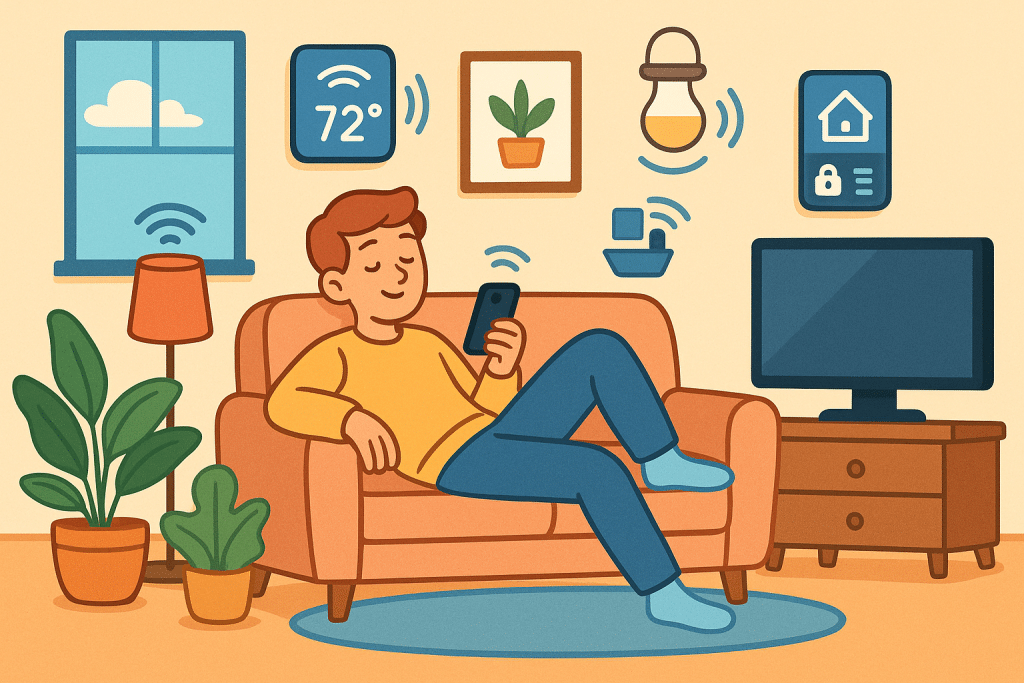
What Defines “Comfort” in Smart Homes Today?
Comfort isn’t just warm or cool. It now includes:
- Perfect climate control (temperature, humidity, airflow)
- Clean air and water, reduced allergens, wellness support
- Ambient lighting and sound that match mood or activity
- Seamless functionality that “fades into the background” rather than being intrusive
With those in mind, the current horizon for smart home comfort trends includes several exciting developments.
Major Trends Shaping Smart Home Comfort in 2025
1. Ambient Sensing & Context-Aware Automation
One of the most interesting shifts is towards homes that sense what’s going on (without you telling them) and adjust automatically.
- Samsung’s SmartThings is extending its device ecosystem (TVs, fridges, speakers) to act as motion and sound sensors. These sensory inputs will allow the system to detect activities like cooking, reading or even drying hair, then adjust lighting, temperature, or air-purifiers accordingly.
- The use of ambient sensing addresses a big comfort issue: rooms often stay conditioned (heated/cooled) even when empty, or lighting remains harsh when you’re relaxing. Context-aware systems can reduce these inefficiencies.
Benefits
- Less manual control: fewer remotes, fewer app toggles
- Energy savings by avoiding wasted conditioning
- Improved wellness: lighting or humidity matched to what you’re doing
2. AI-Integrated Climate Control Systems
Smart thermostats have been around, but the trend now is for deeply learning, adaptive climate systems that go beyond simple scheduling.
- AI-powered cooling systems are being developed that use IoT sensors to track temperature, humidity, occupancy, and exterior weather forecasts, then dynamically adjust settings. Some are projecting up to 40% reductions in electricity consumption relative to non-adaptive cooling systems.
- Deep learning control for Heating, Ventilation, and Air Conditioning (HVAC) systems is maturing, allowing better balance of comfort (e.g. maintaining temperature and humidity within tight bands) and energy efficiency.
What to Look for
- Zoned systems that can treat different rooms differently
- Learning algorithms that adapt based on your patterns (sleep schedule, when you’re home vs away)
- Integration with weather forecasts and outdoor sensors
3. “Invisible” Technology & Wellness-Oriented Design
Another strong trend is tech that blends into the home, both visually and sensorially, plus wellness-focused systems.
- Homes are favoring “invisible tech” — fixtures, lighting, blinds, and appliances designed to be discreet or hidden. That could mean motorized blinds, dimmable recessed lighting, hidden sensors, or appliances integrated into cabinetry.
- Wellness drives: air quality sensors/purifiers, circadian lighting (light color/timing matched to natural day/night cycles), soundscaping, even scent diffusion. These help with sleep quality, mood, and overall wellbeing.
4. Matter & Interoperability: Unified Comfort Control
Smart home comfort is often disrupted when devices don’t work together. This year, the push is for compatibility and unified control.
- Matter protocol is gaining traction, enabling devices from different brands (thermostats, lights, locks) to communicate and be controlled from a single app or hub.
- Platforms are integrating multiple comfort-related functions (air, light, temperature, sound) into fewer apps or even single dashboards.
Why It Matters for Comfort
- Easier to set up routines (“When I wake up, open blinds, raise temperature, turn on gentle lights”)
- Less friction: fewer apps, fewer conflicting schedules
- Cost efficiency over time, as devices from different brands can still function together
How to Adapt These Trends in Your Home: Practical Guide
If you’re interested in upgrading your home comfort, here’s a step-by-step path you can follow:
| Step | What to Do | Key Considerations |
|---|---|---|
| 1. Assess current comfort pain points | Identify the issues:—hot/cold spots, stale air, glare, too much or too little light, noise, etc. | Use your daily routines to map when and where discomfort happens. |
| 2. Check your infrastructure | Good WiFi, hubs that support Matter, enough sensors, proper airflow, window insulation, etc. | Weak WiFi or poor insulation undermines many smart tech benefits. |
| 3. Start with high-impact devices | For climate: smart thermostats or ACs with presence sensors. For wellness: air quality monitors/purifiers, circadian lighting. | Make sure devices can integrate with your future setup (Matter, smart hub). |
| 4. Plan sensor placement | Motion sensors, sound sensors, occupancy sensors in rooms you use often. Hidden sensors if you care about aesthetics. | Sensors are only useful if they sense at the right time and place. |
| 5. Define routines & automations | E.g., “evening mode” dims light, lowers temp, runs air purifier; “wake‐up mode” brings in daylight, raises temperature gradually. | Test and adjust—what feels good in theory may need tweaks. |
| 6. Review and iterate | After a few weeks, note what feels off, what’s over-automated, what you stillcontrol manually. Adjust schedules, sensor sensitivities, etc. | Comfort is highly personal; what works for one may not for another. |
Challenges and Trade-Offs
While these trends promise more comfort, there are practical hurdles:
- Privacy and data security: Ambient sensors and AI need data. Users need assurance about how data is used, stored, and whether it’s shared. Samsung claims some of its sensed data will be stored locally on SmartThings hubs.
- Upfront cost: Smart, adaptive devices cost more initially; retrofitting older homes can be expensive. Cost effectiveness depends on energy cost savings, and the degree of automation.
- Interoperability issues: Not all devices support same standards; Matter is improving this but not universal yet.
- Complexity vs simplicity: Over-automation can lead to frustration if devices act unexpectedly or not as desired. Some people prefer manual overrides.
Hot Example: Hisense’s U8 S Pro Air Conditioner
A current standout device that embodies many of the smart home comfort trends:
- Presence-aware sensors (HI-SENSOR) that detect room occupancy and movement, adjusting airflow, temperature, and humidity automatically.
- Built-in air purification via ion technology, helping maintain cleaner air.
- Even airflow distribution using Coanda effect (90° rotation), which avoids cold drafts or overly cooled spots.
- Voice control with multi-command support, and integration into an AI platform (ConnectLife) that aims to unify control across multiple home appliances.
This AC model is an example of how comfort, air quality, energy savings, and integrated control are coming together.
The Future: What’s Coming Next
Looking ahead, the following are likely next steps in smart home comfort:
- AI + LLM integration: Homes that can understand natural language more deeply, understand preferences and context better (e.g., “I want to sleep in early today”) and adjust automatically. Research shows combining user preference data with LLMs improves personalization significantly.
- More wellness metrics: Incorporation of biometric sensors, stress and health monitoring (sleep, air pollutants, etc.).
- Invisible infrastructure: More devices built into walls, ceilings, furniture; less visible hardware.
- Renewable energy + smart storage: Solar panels, battery storage, smart grid interaction so comfort loads shift when energy is cheaper or greener.
Conclusion
Smart home comfort trends in 2025 are about making living spaces more intuitive, healthier, and convenient. The edge lies not in flashy devices but in systems that understand context, learn preferences, and integrate multiple comfort factors (temperature, air, light, sound) smoothly. If you’re thinking of upgrading, start by identifying comfort gaps, invest in devices that support modern standards (Matter, AI/climate control), and scale gradually while keeping wellness, privacy, and simplicity in view.
References
- Statista. (2023) Smart Home Report 2023 – Comfort and Energy Management. Available at: https://www.statista.com/study/ (Accessed: 21 September 2025).
- Smith, A. and Johnson, T. (2022) The Rise of Smart Home Devices: Enhancing Daily Living. Journal of Consumer Technology, 18(4), pp. 245–260. Available at: https://journals.sagepub.com (Accessed: 21 September 2025).
- U.S. Department of Energy. (2021) Guide to Smart Home Energy and Comfort Innovations. Available at: https://www.energy.gov (Accessed: 21 September 2025).

 Adventure Travel Destinations That Encourage Exploration