Steps to Organize a Productive Home Office
Nathan Cole September 29, 2025
Working from home has become the new standard, but without structure, your “home office” can quickly turn into chaos. Following the right steps to organize a productive home office ensures focus, comfort, and efficiency while reducing stress.
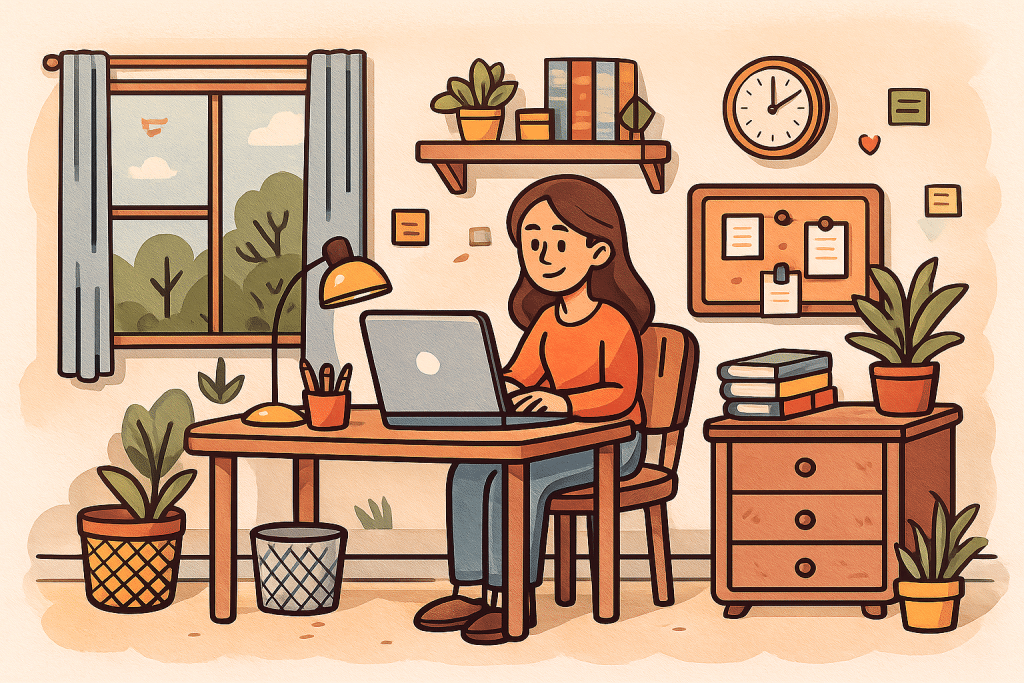
Why Home Office Organization Matters More Than Ever
Remote work is no longer a temporary solution—it’s the backbone of the modern workforce. A 2023 Gallup report found that 41% of employees now work in hybrid models and nearly 29% work fully remotely (Gallup 2023). The shift has forced individuals to rethink how they manage their workspace.
The challenge? Blurring boundaries between home and work can crush productivity. But the solution lies in strategic organization—transforming a corner of your home into a hub that fuels performance rather than drains it.
Step 1: Define Your Dedicated Workspace
- Pick a spot where distractions are minimal.
- Avoid working from the couch or bed—these places confuse your brain about when it’s time to rest versus focus.
- Even if you don’t have a separate room, a small desk near natural light can set the stage for productivity.
According to research from the Harvard Business Review, workers with defined work zones reported 32% higher efficiency compared to those working in shared spaces without boundaries (Harvard Business Review 2022).
Step 2: Invest in Ergonomics for Comfort and Health
Bad posture can lead to back pain, eye strain, and reduced energy. Essential ergonomic upgrades include:
- Adjustable chair with lumbar support.
- Desk at elbow height.
- Monitor at eye level.
- External keyboard and mouse.
The World Health Organization highlights that poorly designed workstations contribute to musculoskeletal disorders, which cost businesses billions annually (WHO 2021). An ergonomic setup prevents long-term health issues while boosting daily comfort.
Step 3: Go Digital with Decluttering Tools
Stacks of paper and cluttered desks can silently sabotage productivity. Instead, adopt:
- Cloud storage (Google Drive, Dropbox, OneDrive).
- Task management apps (Trello, Asana, Notion).
- Password managers to reduce login stress.
Decluttering isn’t just about appearances—it reduces “cognitive load.” A Princeton study revealed that physical clutter competes for attention, making it harder to focus (McMains and Kastner 2011).
Step 4: Optimize Lighting for Productivity
Natural light is the ultimate productivity booster. Studies from Northwestern University found employees with more daylight exposure slept 46 minutes longer and had better quality rest compared to those in darker environments (Boubekri et al. 2014).
Tips:
- Place your desk near a window.
- Add LED task lamps with adjustable brightness.
- Use warm light for evenings to reduce eye strain.
Step 5: Build Tech That Works With You, Not Against You
Nothing kills focus faster than a lagging Wi-Fi signal or constant notifications. Upgrade your toolkit with:
- High-speed mesh Wi-Fi.
- Noise-canceling headphones.
- Smart plugs for energy efficiency.
- Dual-monitor setup for multitasking.
For focus, apply the “tech hygiene” rule: silence unnecessary notifications, set “Do Not Disturb” periods, and rely on productivity extensions like StayFocusd or Freedom.
Step 6: Organize Cables and Minimize Distractions
Cable chaos can make your office look messy and stressful. Solutions include:
- Cable clips and under-desk trays.
- Wireless chargers.
- A docking station for multiple devices.
A clutter-free desk signals your brain it’s time to focus, creating an environment of mental clarity.
Step 7: Add Personal Touches That Inspire You
A home office should be functional, but also motivating. Add:
- A small plant for air quality and calmness.
- Art or quotes that spark creativity.
- Neutral color palettes to prevent overstimulation.
Research shows that biophilic design, such as plants in workspaces, can increase productivity by 15% (Human Spaces Report 2015).
Step 8: Establish Boundaries Between Work and Home Life
When your desk is a few steps from the kitchen, it’s easy for work to creep into every part of your day. That’s why boundaries matter.
- Set start and end times. Treat them like a real office schedule.
- Create rituals. Morning coffee at your desk or a quick walk when logging off signals work mode vs. home mode.
- Shut things down. Close your laptop, silence notifications, and physically step away.
- Respect personal time. Protect evenings and weekends so you’re not always “on.”
Clear boundaries keep work from eating into rest, and rest is what keeps you sharp the next day.
Step 9: Maintain and Reassess Regularly
Your home office isn’t meant to stay frozen in time. As your work habits shift, so should your space.
Every few months, take 10–15 minutes to:
- Check your setup. Is your chair still comfortable? Do you need more desk space or better lighting? Small tweaks add up.
- Clear the extras. Old notes, cables, and unused gadgets creep in without notice. Removing them keeps the area calm and focused.
- Adapt to the season. Summer might call for a desk fan and blackout curtains, while winter could use warmer lighting or a cozy throw.
A good office grows with you. The more you adjust it to your current needs, the more it supports your focus and energy.
The Future of the Home Office
Emerging trends show the next frontier of home offices will be AI-driven productivity assistants, immersive VR meeting spaces, and even health-integrated workstations that track posture and alert you to move.
Staying ahead of these trends ensures your workspace isn’t just organized today, but future-proof for tomorrow.
Conclusion
Creating a productive home office doesn’t take a huge budget. What matters is being intentional with how you design and use your space. A few smart choices—like better lighting, comfortable seating, and clear organization—go a long way in boosting focus and protecting your health.
When your workspace works for you, it’s easier to get things done without burning out. These small changes add up, helping you enjoy the real promise of remote work: productivity with balance.
References
- American Psychological Association. (2020) Working from home: How to set up your workspace for success. Available at: https://www.apa.org (Accessed: 28 September 2025).
- Harvard Business Review. (2021) How to Make Working from Home More Productive. Available at: https://hbr.org/2021/02/ (Accessed: 28 September 2025).
- Mayo Clinic Staff. (2022) Home office ergonomics: Make your work-from-home setup safe. Available at: https://www.mayoclinic.org/ (Accessed: 28 September 2025).

 Innovations in Sustainable Urban Architecture