How AI Supports Business Growth and Innovation
Marcus Liu September 26, 2025
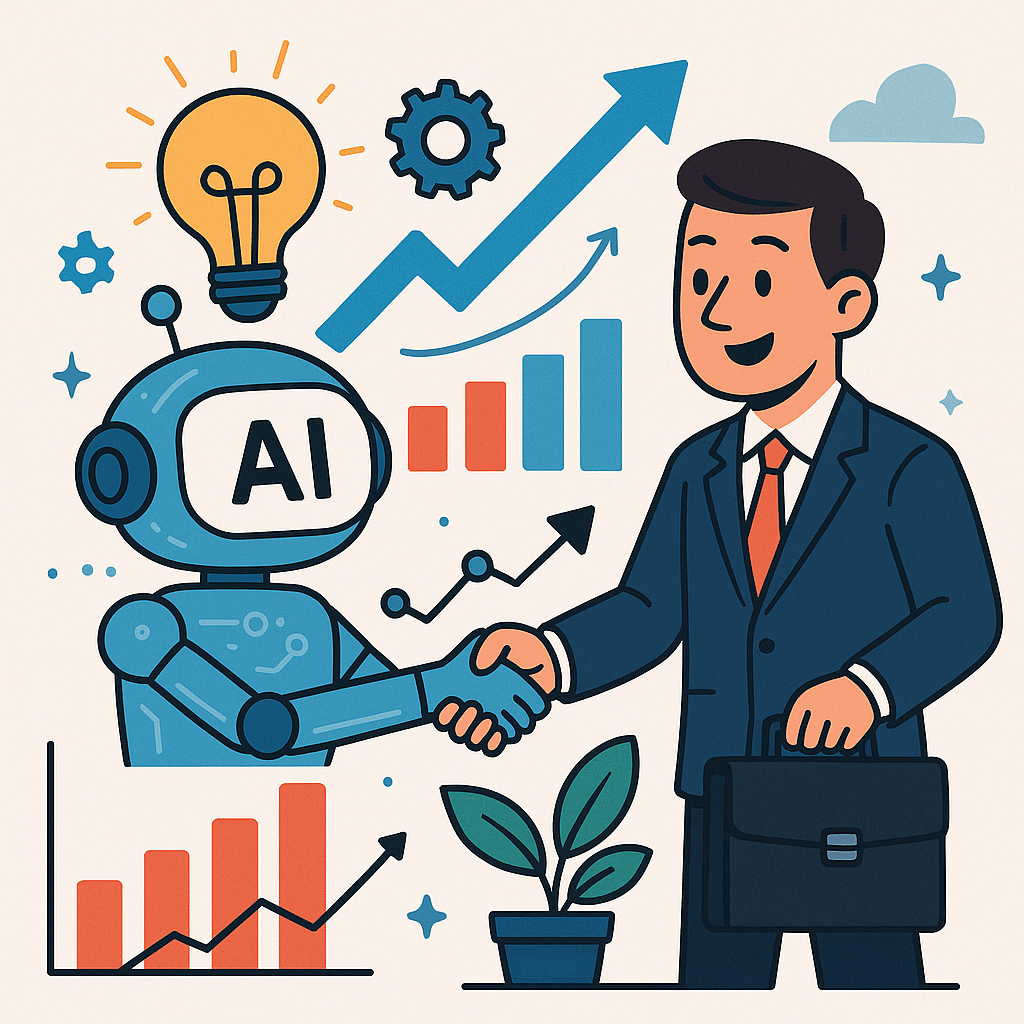
Artificial intelligence (AI) is no longer a futuristic concept—it’s a driving force in how companies grow and innovate. Today, AI supports business growth and innovation by streamlining operations, enhancing decision-making, and opening new market opportunities.
The Rise of AI in Business Strategy
AI has shifted from being a supportive tool to becoming central in business strategies. According to a McKinsey report, 50% of organizations adopted AI in at least one function by 2022, and this number continues to climb (McKinsey 2022). Businesses now view AI as essential for maintaining competitiveness.
Key areas where AI has become indispensable:
Automation of repetitive tasks – AI takes over routine work like scheduling, payroll checks, and basic customer support. This not only reduces the risk of human error but also frees up employees to focus on projects that require critical thinking and creativity.
Data-driven insights – AI can sift through massive datasets and highlight patterns humans might miss. Retailers, for example, use it to forecast demand and adjust inventory, while finance teams rely on it to detect unusual transactions before they turn into problems.
Customer personalization – From Netflix suggesting your next binge to e-commerce sites tailoring product recommendations, AI creates experiences that feel personal. This level of customization builds stronger engagement and makes customers more likely to return.
Cost optimization – Businesses save money by using AI for predictive maintenance, smarter advertising, and efficient resource allocation. It’s not just about cutting costs, but doing so while increasing productivity and performance at the same time.
How AI Supports Business Growth and Innovation
AI supports business growth and innovation by integrating across multiple sectors. From predictive analytics in finance to AI-driven product recommendations in retail, companies use AI to create new revenue streams and reimagine traditional business models.
1. Boosting Efficiency Through Automation
Automation remains one of the most visible impacts of AI. Robotic Process Automation (RPA) handles everything from invoice processing to compliance checks. This allows companies to reduce operational costs by up to 30% (Deloitte 2021).
2. Enhancing Customer Experience
AI-powered chatbots and recommendation engines personalize interactions. For example, Netflix’s recommendation algorithm drives over 80% of its streamed content, showing the massive role personalization plays in revenue growth (Gomez-Uribe & Hunt 2016).
3. Driving Product Innovation
AI accelerates product development cycles. Companies in healthcare are using AI to discover new drugs faster, while automotive firms leverage it for autonomous vehicle technology.
4. Improving Decision-Making
Machine learning models analyze vast data to predict trends, manage risk, and optimize investments. Businesses using AI for forecasting have reported up to a 10% increase in profit margins (PwC 2022).
Emerging AI Trends Shaping Business Growth
Generative AI and Creativity
Generative AI tools like ChatGPT and MidJourney are redefining creativity. Businesses are using them for:
- Marketing copy and campaign ideas
- Product design simulations
- Automated coding for faster software delivery
Generative AI enables startups and established firms alike to scale innovation without proportionally scaling costs.
AI in Supply Chain Resilience
Post-pandemic disruptions highlighted the need for resilient supply chains. AI-powered predictive models now forecast shortages, optimize logistics, and even reduce emissions. Gartner estimates that AI in supply chain management can reduce forecasting errors by up to 50% (Gartner 2022).
Hyper-Personalization in E-commerce
Retailers use AI not just for recommendations but for tailoring entire customer journeys. Dynamic pricing algorithms adjust prices in real time, maximizing both sales and customer satisfaction.
Case Studies: AI in Action
Retail: Walmart’s AI-Driven Inventory Management
Walmart uses AI to optimize stock levels and predict consumer demand. By analyzing seasonal patterns and external factors, it reduces waste while ensuring shelves remain stocked.
Healthcare: AI in Diagnostics
AI tools such as DeepMind’s AI for eye disease detection have matched expert accuracy levels, cutting diagnostic times and expanding access to healthcare innovation (DeepMind 2018).
Finance: Fraud Detection
Banks use machine learning models to detect fraud patterns in milliseconds, preventing billions in losses annually. JPMorgan’s COiN platform reviews legal documents in seconds—a task that once required thousands of lawyer hours.
Challenges in AI Adoption
While the benefits are clear, adopting AI comes with hurdles:
- Data privacy concerns – companies must balance innovation with compliance.
- Bias in AI models – skewed data can reinforce systemic biases.
- Implementation costs – small and mid-sized firms may struggle with upfront investments.
- Skill shortages – there’s a global lack of talent trained in AI development and deployment.
However, governments and institutions are investing heavily in AI upskilling programs, ensuring broader access to AI innovation.
The Future of AI in Business Growth
Looking ahead, AI will play a bigger role in building smarter, greener, and more connected businesses. Beyond efficiency, it will drive sustainability by cutting carbon footprints in logistics, improving energy use in manufacturing, and making supply chains more transparent.
AI will also help companies meet growing ESG demands by automating sustainability reporting and ensuring compliance. At the same time, the rise of affordable, cloud-based AI tools will open the door for startups and SMEs, giving them access to capabilities once reserved for large enterprises.
Another shift will be deeper integration with other technologies. AI paired with IoT will create predictive, self-adjusting systems in factories and logistics, while blockchain will add security and trust to business transactions and data sharing.
Key Future Trends
- AI-driven sustainability reporting for ESG compliance
- Democratization of AI tools for startups and SMEs
- Integration with IoT and blockchain for secure, intelligent ecosystems
- Predictive analytics for faster, data-backed decisions
Conclusion
AI supports business growth and innovation by enabling companies to scale operations, improve efficiency, and create entirely new business models. Despite challenges, the adoption of AI is accelerating across industries. Companies that embrace it today are positioning themselves at the forefront of tomorrow’s economy.
References
- McKinsey & Company. (2022) The State of AI in 2022: Accelerating Impact. Available at: https://www.mckinsey.com(Accessed: 26 September 2025).
- Bughin, J., Seong, J., Manyika, J., Chui, M. and Joshi, R. (2018) Notes from the AI frontier: Modeling the impact of AI on the world economy. McKinsey Global Institute. Available at: https://www.mckinsey.com (Accessed: 26 September 2025).
- PwC. (2023) Sizing the prize: What’s the real value of AI for your business and how can you capitalise?. Available at: https://www.pwc.com/(Accessed: 26 September 2025).

 Travel Planning Tips That Reduce Stress