How Art and Literature Influence Social Development
Nathan Cole September 18, 2025
Art and literature are not just cultural artifacts; they are engines of social development. In 2025, the intersection of creativity, technology, and activism is redefining how societies grow, connect, and transform. From digital art activism to AI-driven literature, creative expression is shaping how communities understand identity, diversity, and even politics.
The Power of Creative Expression in Society
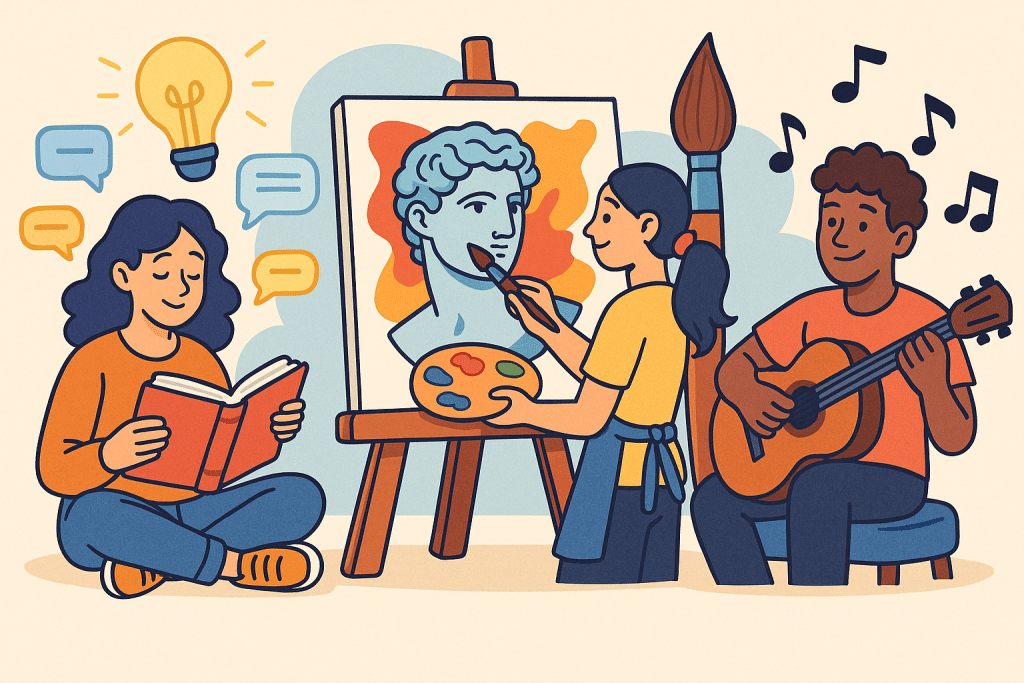
Art and literature have historically been tools for education, protest, and social cohesion. In today’s interconnected world, their influence is magnified by digital platforms that spread ideas globally in seconds.
Literature like Angie Thomas’s The Hate U Give has fueled conversations about racial justice in classrooms worldwide (Thomas, 2017). Street art movements across Europe and Latin America are directly influencing public policy on climate change and housing reforms (BBC, 2023).
Both mediums act as mirrors of society, reflecting injustices while also offering visions of what could be. Visual and literary arts have the ability not only to challenge prevailing power structures but also to unify marginalized voices into a cohesive force for change. Consider the rise of spoken word poetry in youth activism or the resurgence of protest murals in cities like Santiago, Cape Town, and Detroit—these aren’t just aesthetic choices, they’re sociopolitical statements with tangible outcomes (Nasta and Stein, 2020).
Moreover, in the age of Instagram, TikTok, and self-publishing platforms, individuals now have greater autonomy to express their lived experiences without institutional filters. This democratization of creative expression has given rise to grassroots movements, viral campaigns, and global empathy on issues like refugee crises, gender equality, and environmental activism.
Through vibrant storytelling and provocative imagery, art and literature continue to be potent vehicles of awareness and empathy—inviting people not just to observe the world, but to transform it.
Digital Art Activism: The New Protest
Digital art is rapidly becoming one of the strongest forces in modern activism. Artists use platforms like Instagram, TikTok, and NFT marketplaces to share works that challenge inequality, climate inaction, and censorship.
In 2024, researchers noted that digital protest art significantly influenced public opinion during global climate strikes (Smith & Torres, 2024). Unlike traditional protest methods, digital art transcends borders, mobilizing people across continents.
From AI-generated posters to animated loops protesting war or corruption, these digital tools give artists a safe yet powerful way to resist injustice. In countries facing censorship, creatives use encrypted sharing apps and NFTs to bypass restrictions (Lee, 2023).
What makes digital art activism unstoppable is its reach—every meme, reel, or visual protest can instantly go global. The revolution isn’t on the streets anymore. It’s viral. It’s visual. And it’s in your feed.
Literature as a Tool for Social Development
Books, poetry, and essays continue to reshape social narratives. A growing trend is “literary activism,” where authors use storytelling not just for art but for tangible change.
For example, Margaret Atwood’s dystopian themes inspired global feminist movements, while younger authors like Rupi Kaur make poetry accessible to new generations. These works drive discussions on gender, mental health, and identity, creating shared frameworks for social progress.
Recent studies confirm that reading increases empathy, which is crucial for building inclusive societies (Mar, Oatley, & Peterson, 2009). This suggests that literature remains a vital tool for functional social development.
Technology, AI, and Creative Futures
Emerging technologies are expanding what art and literature can achieve—and they’re doing it fast.
AI Literature
AI Literature is no longer a niche curiosity. Tools like ChatGPT are now co-authoring novels, screenplays, and poetry collections, fundamentally reshaping our understanding of authorship. This shift is sparking global debates about originality, intellectual property, and what it truly means to “create” in the digital age. AI-generated books like Death of an Author by Aidan Marchine—a pseudonym for an AI-human collaboration—are already being reviewed by mainstream literary critics (Flood, 2023).
Virtual Reality Exhibits
Virtual Reality Exhibits are pushing the boundaries of empathy in storytelling. Museums and independent creators alike are using immersive VR to transport viewers into the heart of global crises—such as refugee journeys, natural disasters, and war zones—allowing them to witness human experiences from a visceral, first-person perspective. These installations aren’t just artistic—they’re educational tools used in classrooms and public policy discussions alike (Grau, 2021).
Digital Libraries
Digital Libraries are democratizing knowledge like never before. Platforms like Project Gutenberg and the Internet Archive offer free access to millions of books, manuscripts, and academic texts, breaking down barriers to education and culture. And with mobile-first design, these libraries now reach underserved communities across the globe—bringing Shakespeare, Tolstoy, and Toni Morrison to rural villages and inner cities alike.
Augmented Reality (AR)
Augmented Reality (AR) is also finding its place in creative spaces. Artists are overlaying digital art onto physical spaces, creating location-specific experiences that interact with the viewer in real time. Imagine walking through a park and seeing digital sculptures bloom via your phone. It’s not science fiction—it’s already happening in major cities through projects like Snap AR and Adobe Aero.
NFTs and Blockchain Art
NFTs and Blockchain Art are transforming the concept of ownership in the art world. With digital provenance built into the blockchain, artists are now earning royalties on resales—a concept almost nonexistent in traditional art markets. This model is giving independent creators unprecedented financial control over their work (Kugler, 2021).
AI-Driven Music Composition
AI-Driven Music Composition tools like AIVA and Amper Music are letting both professional composers and amateurs generate scores within minutes. While purists criticize this as “soulless,” others argue it democratizes composition, allowing anyone with an idea to turn it into sound.
Crowdsourced Storytelling Platforms
Crowdsourced Storytelling Platforms like Wattpad and Tapas are gaining momentum as well, driven in part by AI-assisted feedback systems. These platforms reward interactivity and reader engagement, offering writers real-time input and even deals with film studios and publishers.
In this rapidly evolving landscape, one thing is certain: technology is not just a tool—it’s becoming a co-creator, a collaborator, and in some cases, a provocateur in the arts relationship between art, literature, and society is becoming more immersive, inclusive, and immediate.
Education and Social Cohesion Through Arts
Schools and universities are increasingly integrating art and literature into curriculums not just as electives, but as core tools for civic education. UNESCO (2022) emphasizes that creative education fosters tolerance, innovation, and resilience in societies facing polarization.
By teaching students how to interpret stories and images critically, educational systems prepare them to navigate misinformation, cultural diversity, and political conflict more effectively.
Challenges: Censorship and Commercialization
Despite progress, challenges remain. In several countries, books addressing LGBTQ+ rights or histories of colonialism face bans. Similarly, art is often commodified, raising concerns about whether its social power is diluted by profit-driven models like NFTs.
Balancing freedom of expression with accessibility is a pressing issue. As societies negotiate this balance, art and literature will continue to test the limits of social transformation.
Conclusion: A Future Shaped by Creativity
The influence of art and literature on social development is not new, but the scale and speed at which they operate in 2025 is unprecedented. They foster empathy, mobilize protests, and create new spaces for dialogue. As digital technologies expand their reach, the role of creativity in shaping societies will only grow stronger.
For communities seeking functional progress, investing in art and literature is not optional—it’s essential.
References
- Nussbaum, M.C. (2010) Not for profit: Why democracy needs the humanities. Princeton: Princeton University Press. Available at: https://press.princeton.edu(Accessed: 17 September 2025).
- Eagleton, T. (2012) The event of literature. New Haven: Yale University Press. Available at: https://yalebooks.yale.edu (Accessed: 17 September 2025).
- UNESCO (2019) ‘Culture for sustainable development’, United Nations Educational, Scientific and Cultural Organization. Available at: https://en.unesco.org(Accessed: 17 September 2025).

 Innovations in Robotics That Improve Everyday Tasks