Innovations in Robotics That Improve Everyday Tasks
Marcus Liu September 18, 2025
Hands-free coffee, elder support, chore automation — this isn’t sci-fi, it’s the next stage in robotics. What’s driving household robots beyond single chores to general-purpose robotic helpers that can adapt, learn, and assist across many tasks.
In this article we explore emerging innovations in robotics that improve everyday tasks, especially through general-purpose manipulation, AI learning, and assistive models. You’ll learn about recent breakthroughs, real challenges, and what you can expect in homes in the near future.
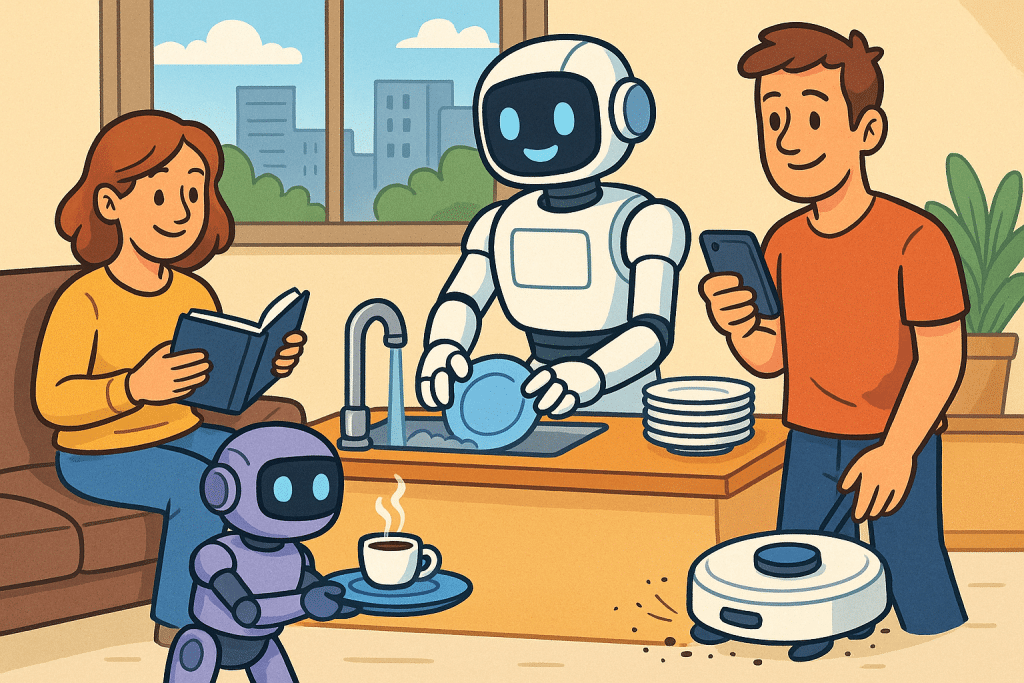
What Is a General-Purpose Robot?
A general-purpose robot is designed not just to do one thing (like vacuuming or mowing the lawn), but to handle a variety of household tasks — moving, grasping, navigating, interacting with unpredictable objects — ideally with minimal human supervision. This entails skills like:
- dexterous manipulation (grasping, twist, push, pull)
- perception in varied environments
- navigation across uneven or cluttered spaces
- adapting to new, untrained tasks (zero-shot or transfer learning)
This goes beyond the robots that do repetitive chores; it’s robotics with flexibility, intelligence, and adaptability.
Key Innovations Making General-Purpose Robots Practical
Recent developments are closing the gap between demo-robots and useful home assistants. Some of the most significant innovations include:
1. AI Models That Generalize
Models like Gemini Robotics from Google DeepMind are built to take in vision, language, and action inputs so robots can handle tasks they’ve never explicitly been trained on. For example, folding paper, unscrewing jar lids, recognizing new objects, all become feasible.
This kind of AI generalization is critical: it means robots will be more useful in real homes, where environments are messy, varied, and unpredictable.
2. Whole-Body Manipulation Suites
The BEHAVIOR Robot Suite (BRS) is an example of robotics hardware + learning frameworks aimed at real‐world household tasks. It incorporates bimanual coordination (using both robot “arms”), stable navigation, reachability across a torso extension, and learned visuomotor policies to manipulate articulated or deformable objects.
So robots are getting more capable physically, not just “smart” in algorithmic sense.
3. Assistive Robots for Eldercare and Human Mobility
Robot designs are increasingly focused on supporting people directly, especially the elderly. For instance, MIT researchers have developed eldercare robots that help people sit and stand, and catch them if they fall. These don’t replace human caregivers but can improve safety and independence.
Also, soft robotics / robots with compliant materials are safer around humans. They reduce risk in close interactions like helping with dressing, moving about, or daily personal tasks.
Real-World Examples You Can See Now or Soon
To make concrete what these innovations mean, here are a few recent projects, prototypes, or companies pushing general-purpose robots forward:
- Ant Group’s R1 humanoid robot: demonstrated at IFA 2025 making shrimp in a kitchen—showing how humanoids are starting to perform standard kitchen tasks.
- Tesla’s Optimus has been shown in demos doing small, purposeful tasks (serving popcorn, etc.), emphasizing its evolving motor precision and autonomy.
- Robot suites like BRS that combine hardware, navigation, and learning for manipulating items in realistic household settings.
What’s Changing: Trends Driving Uptake
Why are general-purpose household robots starting to move from labs to living rooms?
- Aging populations: More people want solutions to stay at home longer, safely. Robots that assist with mobility, fall prevention, chores, etc., will be high demand.
- Advances in AI + perception: Better vision, better models that combine vision + action + language allow robots to interpret verbal directions, recognize new objects, adapt to moved furniture, etc.
- Hardware improvements: Softer materials, lighter, more articulate joints; better sensors; safer interaction modes.
- Open frameworks and benchmarks: Platforms like BRS, robot learning datasets, standard challenges are accelerating development. Researchers share code/hardware so progress is more cumulative.
Challenges That Still Need Solving
While the promise is large, there are serious obstacles before general-purpose household robots are common and reliable.
| Challenge | Details |
|---|---|
| Robustness & safety in varied environments | Floors, lighting, clutter, pets, children—these vary hugely. Robots need to operate safely without damaging things or harming people. |
| Cost & affordability | High-degree-of-freedom manipulators, sensors, AI compute all cost. Making that work at low price is hard. |
| Energy / battery life | Moves, lifting, perception need power; robots need to balance capability with long enough uptime. |
| Generalization vs specialization trade-offs | A robot built to do many tasks may never do any one task as well as a specialized device. Which balance is most useful depends on user needs. |
| User interaction / trust | People need robots they trust, that understand instructions, adapt, avoid breakage, be easy to maintain. |
What to Expect in Homes by 2028–2030
Based on current progress, here are predictions and what consumers might see in coming years.
- Hybrid systems: A mix of specialized robots (vacuuming, lawn mowing, window cleaning) plus one general-purpose assistant for messier, multi-step tasks like tidying, fetching, maybe cooking assistance.
- Improved voice/visual control: Robots that understand natural language instructions (e.g. “pick up that wine glass”) and can locate objects even if moved.
- Assistive robots for eldercare will become more common—helping seniors stand up, monitoring for falls, prompting medication, etc.
- Modular hardware + upgradeability: Houses may buy base robot platforms, then add new limbs, manipulators, or sensors over time (plug-and-play).
- Safety certifications, standards raised: regulation and safety checks will be needed before these robots are used in homes widely.
How to Prepare
If you’re excited about getting one of these general-purpose robots when they become available, here are tips to keep in mind:
- Follow developments in open projects like Gemini Robotics, BEHAVIOR Robot Suite. These often produce early adopter opportunities and prototypes.
- Think about your home layout: less clutter, clear floors, easy surfaces, so robot navigation is easier.
- Invest in smart home infrastructure: good lighting, voice assistants, IoT devices that can be bridged to robot systems.
- Watch for demo/test programs: many robotics startups will let users test in controlled settings before commercial launch.
Are We Already There?
Not fully. Many of the robots currently demonstrated are still limited: slow, fragile, expensive, or needing human supervision. But the trend is unmistakable. Innovations in robotics that improve everyday tasks via general-purpose manipulation are closing the gap between possibility and domestic reality. In many labs and pilot programs, robots are doing more than one chore, adapting to unknown settings, perceiving new objects—and that was hard just a few years ago.
Conclusion
The robotics landscape is changing. Rather than robots that only sweep floors or mow lawns, we are entering a phase where robots can handle multiple tasks, adapt, learn, and assist in homes in meaningful ways. While obstacles remain in cost, safety, and reliability, the major breakthroughs in AI learning models, whole-body manipulation, and assistive designs for eldercare point to a future where household chores, mobility tasks, and home support are increasingly automated.
If you care about saving time, supporting loved ones, or simply having a smarter home, general-purpose robots are among the innovations to watch.
References
- Chui, M., Manyika, J. and Miremadi, M. (2016) Where machines could replace humans—and where they can’t (yet). McKinsey & Company. Available at: https://www.mckinsey.com (Accessed: 17 September 2025).
- International Federation of Robotics (2022) World Robotics Report 2022. IFR. Available at: https://ifr.org/Accessed: 17 September 2025).
- Vincent, J. (2023) How AI-powered robots are changing the workplace. The Verge. Available at: https://www.theverge.com (Accessed: 17 September 2025).

 Steps to Make Your Home More Organized and Functional