Fitness Routines That Support Healthy Aging
Lucia Fernandez October 1, 2025
Everyone grows older. But as we age, staying active becomes not just optional but essential — and fitness routines healthy aging is no longer a fringe topic. At least for those who want to enjoy some level of independence in their old age. In 2025, new trends and research are reshaping how older adults stay strong, agile, and resilient. Below we explore the hottest, evidence‑backed routines you can adopt now.
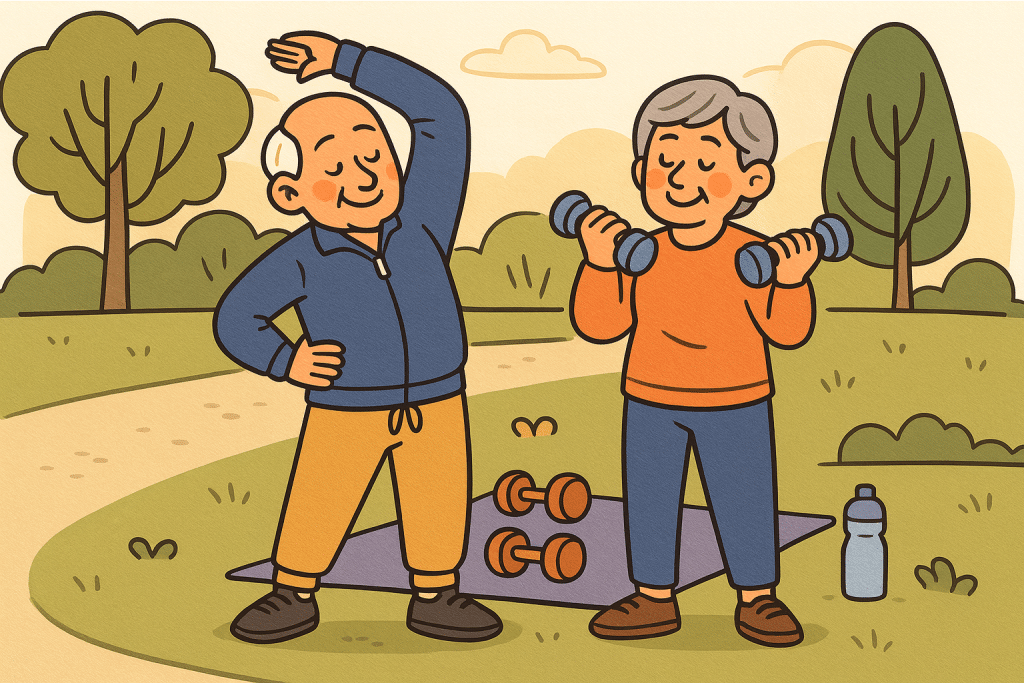
Why “Fitness Routines Healthy Aging” Matters Now
Aging naturally brings muscle loss (sarcopenia), lower bone density, slower metabolism, and reduced balance. But targeted exercise can slow or even reverse many of these changes. According to the NIH, strength training over decades has been shown to help maintain muscle strength, bone health, and functional independence).
Moreover, older adults who strength train at least twice weekly have been shown to have a 46% lower risk of all‑cause mortality compared to those who don’t. That’s not trivial — effective fitness routines built around healthy aging can meaningfully extend both quality and length of life.
The concept of “fitness routines healthy aging” is becoming a top trend: the American College of Sports Medicine (ACSM) lists “fitness programs for older adults” as one of the top trends for 2025.
Hot & Emerging Trends in Fitness for Healthy Aging
1. High‑Intensity Resistance Training (HIRT) for Seniors
The term “high intensity” no longer belongs just to young athletes. Studies reveal that older adults can benefit from resistance training at intensities above 75% of their one‑rep max (1RM).
High-load, progressive resistance training not only preserves muscle but also improves efficiency: for instance, very heavy strength training can reduce the oxygen cost of walking, making daily movement easier.
A meta‑analysis confirms that intensities above 75% 1RM tend to produce greater strength gains than moderate or low intensities.
Practical tip: Begin with 2–3 sets per muscle group, 8–12 reps, 2–3 times per week, and gradually increase resistance as you adapt.
2. Power & Velocity Training (Fast Movements)
Strength is essential, but power (force × speed) declines faster with age and is more directly linked to fall risk and functional mobility).
Training with moderate loads (e.g. 40–60% 1RM) but executed at higher velocity improves reaction, muscle recruitment, and real‑world performance (like rising quickly from a chair) more than slow lifts alone.
Sample exercise: Seated leg press or chest press performed with a controlled, rapid “push” phase.
3. Multi‑Component Routines: Balance, Flexibility & Functional Work
Muscle strength is crucial, but healthy aging requires more than just lifting weights. Multi-component routines integrate:
- Balance drills (e.g. single-leg stands, tandem walking)
- Mobility work (dynamic stretching, joint rotations)
- Functional movement patterns (squats, lunges, pushes/pulls)
These elements help reduce fall risk and improve daily function. A meta-analysis of nearly 20,000 older adults showed structured exercise reduced falls by ~21%.
Tip: Combine a 30‑minute resistance session with 10 minutes of balance/flexibility work, 2–3 times per week.
4. Wearable Tech & Data‑Driven Personalization
One of the top trends for 2025 is the increasing integration of wearable devices into senior fitness.
These devices — smartwatches, fitness bands, even AI coaching apps — allow real-time feedback on:
- Heart rate variability
- Recovery metrics
- Movement quality
- Volume and load tracking
Such feedback helps users adjust intensity, avoid overtraining, and sustain consistency — critical for fitness routines healthy aging.
5. Nutritional Synergy & Supplementation (e.g. Creatine)
Fitness is half the story; adequate nutrition ensures adaptation. Recent research is reviving interest in creatine supplementation for older adults as an adjunct to resistance training. Combining creatine with structured exercise amplifies gains in muscle mass, strength, and even cognitive benefits (Candow et al., 2024).
While supplementation isn’t mandatory, ensuring sufficient protein (1.2–1.5 g/kg body weight) alongside resistance work boosts outcomes.
A Sample Weekly Routine: Putting It All Together
Below is a sample 5‑day plan tailored for healthy aging. Modify it to your level, schedule, or any medical conditions (after consulting your physician).
| Day | Focus | Example Exercises* | Notes |
|---|---|---|---|
| Monday | Lower body + power | Squats, leg press, jump squat or explosive step-ups | Use moderate to high load, 2–3 sets |
| Tuesday | Balance & mobility | Single-leg balance, dynamic stretches, core work | 20–30 minutes |
| Wednesday | Upper body + power | Chest press, rows, fast push-ups, band speed work | Include eccentric control |
| Thursday | Active recovery / cardio | Brisk walking, Nordic walking, cycling | Keep heart rate light to moderate |
| Friday | Full-body + functional | Deadlifts, lunges, overhead presses, carry movements | Focus on functional patterns |
| Saturday/Sunday | Rest or gentle movement | Yoga, walking, stretching | Use restful activities |
*Warm up with 5–10 minutes of light cardio and mobility work; cool down with gentle stretching.
Be sure to gradually increase load or complexity (progression) every few weeks to maintain stimulus.
Overcoming Common Barriers
Older adults often cite concerns like safety, pain, or lack of knowledge as barriers to exercise.
Here’s how to mitigate them:
- Supervision & coaching — even short instruction reduces injury risk
- Start light — initial loads at 40–50% 1RM allow adaptation
- Use good equipment/machines — controlled movements lower joint stress
- Group classes or peer support — social motivation boosts consistency
- Regular reassessment — track 1RM, balance, mobility to adjust plan
Evidence Highlights & Key Takeaways
- Resistance training is safe and effective for older adults, even into the 80s.
- Loads above ~75% of 1RM often yield superior strength gains.
- Training with velocity (power work) connects more directly to daily tasks and fall prevention than strength alone.
- Structured programs combining strength, balance, and mobility reduce fall risks by 17–21%.
- Tech and data tools help tailor training to individual recovery and capacity — lowering injury risk .
- Nutritional support (especially creatine + protein) enhances outcomes.
Final Thoughts
In 2025, fitness routines healthy aging is more than a buzz — it’s an imperative. A smart, evidence‑based approach combining resistance, power, balance, and tech feedback can sustain independence, vitality, and quality of life well into later decades.
Start small, track progress, and adapt. With consistency, you’re not just managing aging — you’re shaping it.
References
Di Lorito, C., van der Wardt, V., Christopher, G., et al. (2020). Exercise interventions for older adults: A systematic review. BMC Geriatrics. https://www.ncbi.nlm.nih.gov/pmc/articles
Subramanian, V., Alvarado, J., & Speth, R. (2025). Cardiovascular Aging and Exercise: Implications for Heart Health. Circulation Research. https://www.ahajournals.org/
Ramos‑Álvarez, O., Roldán‑Aguilar, E. E., Altamiranda‑Saavedra, M., Marín, J. C., & Arufe‑Giráldez, V. (2025). Effects of Exercise on Physical Fitness in Older Adults with and Without Severe Cognitive Impairment. Behavioral Sciences, 15(3), 351. https://doi.org/

 Travel Experiences That Encourage Cultural Understanding