Fitness Routines That Improve Strength and Flexibility
Lucia Fernandez September 24, 2025
Fitness routines that improve strength and flexibility are evolving fast, with hybrid training methods and mobility-focused workouts becoming the backbone of modern exercise. In 2025, trends like mobility training, functional strength, and hybrid yoga workouts are redefining how people train smarter, not just harder.
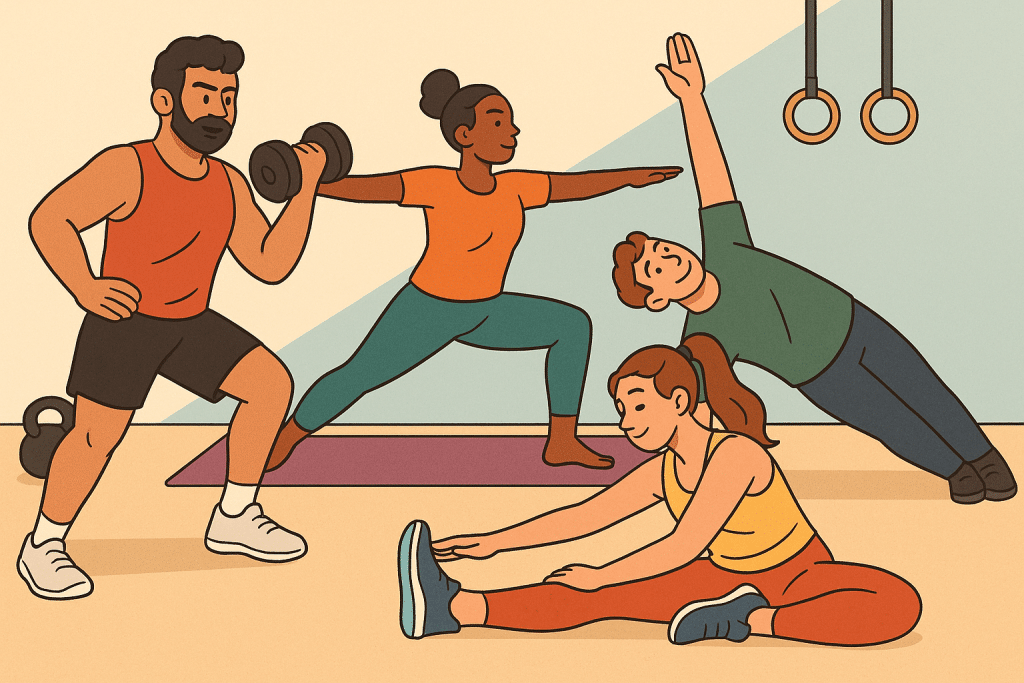
Why Strength and Flexibility Training Matters
Strength and flexibility are no longer viewed as separate goals. Today, athletes, fitness enthusiasts, and everyday gym-goers recognize that both are essential for injury prevention, performance, and long-term health. According to the American Council on Exercise (ACE), combining strength and flexibility can enhance joint stability, reduce pain, and improve overall functional movement (ACE 2023).
Put simply: you don’t just want muscles—you want muscles that move well.
Trend #1: Mobility Training Becomes Mainstream
Mobility training has exploded in popularity in 2025. Unlike static stretching, mobility drills emphasize active, controlled movement through a full range of motion. Think of deep squat holds, hip openers, and thoracic spine rotations.
- Why it’s hot: Tech-driven platforms like Pliability and GOWOD are gamifying mobility with AI-guided routines.
- Benefits: Studies show that mobility training can reduce injury risk and improve athletic performance by up to 30% (Behm et al. 2021).
Mobility sessions now often replace warm-ups, serving as a daily “movement hygiene” ritual for athletes and office workers alike.
Trend #2: Functional Strength Training for Real Life
Barbells and dumbbells remain essential, but there’s a shift toward functional strength exercises—movements that mimic real-life activities.
Examples include:
- Kettlebell Turkish get-ups (strength + coordination)
- Farmer’s carries (core + grip endurance)
- Single-leg deadlifts (balance + hip strength)
Functional training emphasizes core stability and multiplanar movement, making it especially effective for older adults. Research published in the Journal of Strength and Conditioning Research found that functional training significantly improved balance and reduced fall risk in seniors (de Resende-Neto et al. 2019).
Trend #3: Hybrid Workouts—Yoga Meets Strength Training
Gone are the days of choosing between yoga and lifting weights. Hybrid programs like “Power Yoga Strength” and “Mobility Barbell” blend strength training with yoga-inspired flexibility work.
- Why people love it: These workouts provide both sweat and stretch in under 45 minutes.
- Hot example: “Animal Flow,” a bodyweight system that combines yoga, gymnastics, and breakdancing, is gaining traction in boutique studios and online platforms.
This integration appeals to busy professionals seeking efficient, all-in-one workouts.
Trend #4: AI-Powered Personalized Training
Artificial intelligence is reshaping how we train. Wearables like Whoop and Oura Ring track recovery, mobility, and strain, then recommend routines to balance strength and flexibility.
- Apps can now auto-generate mobility drills based on your soreness or movement restrictions.
- Personalized recommendations improve adherence, making AI one of the biggest disruptors in fitness tech.
In 2025, the line between physical therapist and fitness coach is blurring, thanks to data-driven customization.
Trend #5: Isometric and Eccentric Training
Instead of just moving weights up and down, many routines now emphasize time under tension—holding positions (isometric) or focusing on the lowering phase (eccentric).
- Isometrics (like wall sits or planks) build strength without joint strain.
- Eccentrics (like slow squats) improve flexibility by lengthening muscles under load.
A 2020 study in Frontiers in Physiology confirmed that eccentric training improves both muscle strength and flexibility more effectively than traditional concentric-only training (Douglas et al. 2020).
How to Build Your Own Strength + Flexibility Routine
Here’s a practical template anyone can follow 3–4 times a week:
Warm-Up (5–10 min)
- Cat-cow stretches
- Deep squat hold with hip mobility shifts
- Arm circles and thoracic twists
Strength Block (20–25 min)
- Kettlebell swings (3 x 12)
- Bulgarian split squats (3 x 10 each side)
- Pull-ups or assisted pull-ups (3 x 6–10)
- Farmer’s carry (3 x 30 seconds)
Flexibility & Mobility Block (10–15 min)
- Pigeon pose stretch
- Shoulder dislocates with a band
- Hamstring eccentric stretches (Nordic curls or assisted)
Core + Stability (5 min)
- Side planks with hip dips
- Bird-dogs
This hybrid routine targets both strength and flexibility while keeping sessions under an hour.
Future Outlook: Where Fitness is Headed
The future of fitness routines that improve strength and flexibility lies in integration and personalization. Instead of rigid programs that treat every participant the same, we’re moving into an era where training adapts to individual needs, goals, and lifestyles.
We’re already seeing early signs:
- Hybrid studios are becoming the new standard. Rather than selling only yoga or only strength training, gyms are packaging strength, yoga, mobility drills, and recovery sessions into one membership. This approach keeps people engaged and reduces injury risk while helping them hit multiple goals at once.
- AI-driven coaching is moving beyond calorie counting and into mobility and movement assessments. Apps and wearables can now detect your range of motion, spot weaknesses, and suggest corrective routines tailored to your body. This is a big shift from one-size-fits-all fitness programs.
- Longevity-focused training is gaining traction. Instead of chasing aesthetics alone, people are training for functional independence as they age. Strength and flexibility aren’t just for athletes—they’re becoming key to maintaining balance, avoiding falls, and preserving quality of life well into your 70s and 80s.
Another major trend is the blending of fitness with wellness. Expect more partnerships between gyms, physiotherapists, and mental health professionals. Mobility work is increasingly linked to stress relief, pain management, and even better sleep. By 2030, experts predict mobility and flexibility training will be as common as cardio in gyms worldwide (NASM 2024).
Finally, the social side of fitness is changing. Virtual classes, community apps, and gamified platforms will keep people accountable and connected. Whether it’s a live yoga class streamed to your living room or an app that nudges you to stretch during work hours, the future looks less like a “gym trip” and more like fitness seamlessly woven into daily life.
Conclusion
Fitness routines that improve strength and flexibility are no longer niche—they’re the foundation of modern training. From AI-powered personalization to hybrid yoga-lifting classes, the focus is on moving well, not just lifting heavy. Whether you’re a seasoned athlete or someone just getting started, blending strength and flexibility is the smartest investment in your health for 2025 and beyond.
References
Harvard Health Publishing. (2021) Flexibility exercises: Why stretching matters. Harvard Medical School. Available at: https://www.health.harvard.edu/ (Accessed: 23 September 2025).
American Council on Exercise (ACE). (2020) Strength training basics: Benefits and exercises. ACE Fitness. Available at: https://www.acefitness.org/ (Accessed: 23 September 2025).
National Institute on Aging. (2019) Exercise and physical activity: Your everyday guide from the National Institute on Aging. National Institutes of Health. Available at: https://www.nia.nih.gov/health. (Accessed: 23 September 2025).

 Interior Design Ideas That Maximize Natural Light