Smart Home Devices That Simplify Daily Tasks
Giulia Bianchi September 24, 2025
In 2025, AI-powered smart home automation is no longer a luxury: it’s dramatically simplifying daily tasks—from lighting and climate control to safety and entertainment—making homes more intuitive, efficient, and responsive than ever.
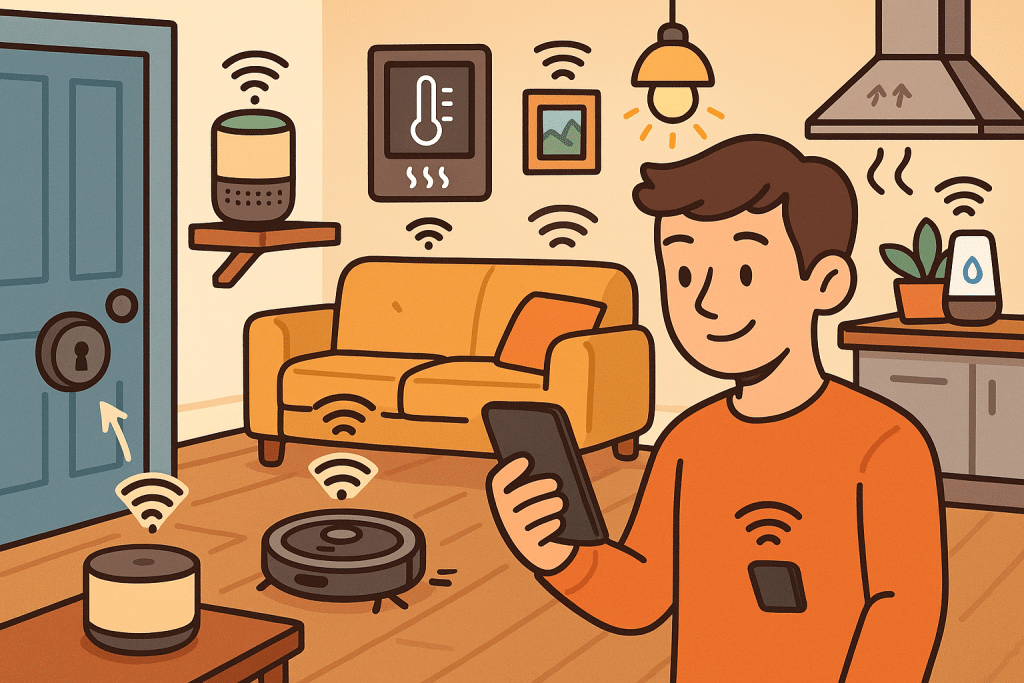
Why AI-Powered Smart Home Automation Is the Big Trend
Smart home technology has been evolving for years, but two forces are driving a particularly rapid change in how these devices help with everyday routines:
- Interoperability / Universal Standards
The long-standing issue of smart devices working only in silos (brand-locked systems) is fading. The adoption of universal protocols like Matter allows devices from different manufacturers to communicate and coordinate more smoothly. This means your thermostat, lights, locks, and speakers can integrate in a single automation routine. - Predictive & Contextual Automation via AI
Instead of reacting to explicit commands (“turn on lights”, “start coffee”), devices are learning from your patterns (when you wake up, leave home, arrive back, bedtimes etc.), and anticipating what you need. Routines can trigger automatically based on location, time, occupancy, or even the weather. This reduces friction significantly.
Together, these trends mean smart home devices are moving from “you ask, they do” to “they observe, they help”.
Key Devices & Innovations That Are Simplifying Daily Tasks
Here are several categories of smart devices (or innovations) that are especially relevant now, with examples of how they simplify everyday tasks.
1. Smart Thermostats & Climate Controllers
- These adjust heating or cooling based on whether someone is home, current weather, and learned preferences. No more manually fiddling with thermostats.
- Some new models integrate with solar or energy pricing signals to run when electricity is cheapest.
- Example: thermostats that learn occupancy, detect open windows, pre-heat or pre-cool as you return. This saves energy and effort.
2. Smart Lighting & Smart Buttons
- Lighting systems that dim, change color, or turn on/off based on time of day, motion detectors, or routines tied to, say, waking up or going to bed.
- Devices like the Lifx Luna smart lamp are bringing affordable smart lighting that works over Matter, making integration easier. It allows scheduling routines (sunrise alarms etc.).
- Also, smart buttons (wall-mountable or movable) that let you trigger routines (lights off + music off, lights on + coffee etc.) with gestures or a tap. These reduce dependence on voice or phone apps.
3. Voice & AI Assistants that Coordinate Tasks
- Assistants are becoming more natural and capable. New releases (e.g. “Gemini for Home” from Google) aim to coordinate multiple devices, understand multi-step commands, and manage complex routines hands-free.
- Voice control is not just about switching things on/off; it’s about combination commands, scene setting (“movie night mode”, “away mode”), or troubleshooting (“what’s wrong with my fridge?”).
4. Smart Appliances & Home Robots
- Kitchen appliances that preheat, suggest recipes based on what’s in the fridge, start/stop remotely.
- Cleaning robots (vacuum, mopping) that map homes and clean on schedules or in response to dirt/humidity sensors. The user doesn’t need to plan each cleaning.
- Innovators are also building devices that consider safety and health (air purification that senses pollutants, medical-alert systems, etc.).
5. Energy & Utility Management Automation
- Smart plugs, power monitoring, scheduling heavy-load devices (e.g. water heater, washing machine) to run at off-peak hours or when electricity is cheaper.
- Interconnected sensors minimize waste (lights off in unused rooms, HVAC reduced when windows open or rooms empty).
- These features reduce not only effort but cost, especially in places with high energy expense.
How to Make Your Smart Home Actually Simplify Tasks (A Practical Guide)
You may have many smart devices already, but the real value comes when they work together. Here are steps to set things up so the simplification is real, smooth, and satisfying.
| Step | What to Do | Why It Matters |
|---|---|---|
| 1. Choose interoperable devices | Look for Matter-certified products or those that explicitly support cross-platform communication (e.g. works with Alexa, Google Home, Apple Home). | Prevents getting locked in and ensures future devices you buy will integrate. |
| 2. Define routines based on your day-to-day | Think: what tasks you repeat (morning routine, work/leisure, arrival home, sleep). Map them out. | Makes automation meaningful—routines cover more than single tasks. |
| 3. Use sensors & triggers, not just timers | Occupancy sensors, motion detectors, door sensors, geofencing (phone/location), even weather sensors. | More context = fewer false/annoying automations (lights don’t turn off when you’re just standing still etc.). |
| 4. Start small & iterate | Maybe begin with lights + thermostat + plugs. Then add kitchen, security etc. | Keeps setup manageable; you learn what works for your context. |
| 5. Ensure good connectivity & privacy | Reliable WiFi / mesh networks, secure accounts, updates enabled. | A smart home that disconnects or leaks data becomes more trouble than help. |
| 6. Monitor & adjust | Use apps or dashboards to see energy savings, find routines that misfire. Adjust schedules or triggers. | Keeps things efficient; ensures you’re getting the benefit in time and money saved. |
Key Challenges & What’s Being Tackled
While the trend is strong, there are still obstacles. Recognizing them helps in setting realistic expectations.
- Compatibility gaps. Even with Matter, not all devices immediately update, and older devices may not support newer standards.
- AI mistakes or mispredictions. False triggers, misunderstood routines. Sometimes AI may need oversight.
- Cost vs Benefit. Smart devices cost more, and benefits (e.g. energy savings) depend on electricity pricing and usage.
- Privacy & Security. Devices collecting data, voice assistants always listening, remote access – you need to ensure devices are secured, have firmware updated, and use strong passwords.
- Complexity creep. When many devices and many routines are set up, maintenance becomes heavy unless you stay organized (good naming, consistent logic).
The smart home field is aware of these. Many device manufacturers now issue regular updates for security; AI systems are improving at learning without overstepping; budgets are more flexible; and user interfaces are becoming more intuitive. Also, many recent surveys show that consumers expect automation of cleaning, lighting, etc., to increase significantly over the next few years.
What to Look Out for in the Near Future
Here are emerging developments that may further simplify daily tasks in smart homes:
- Edge-AI & on-device intelligence (less reliance on cloud, faster response, more privacy)
- Expanded predictive capabilities (e.g. a device noticing you run low on groceries, or anticipating what you need before you realize)
- More robust health & wellness integration (air quality, sleep monitoring, fall detection etc.) especially as populations age.
- Better energy grid integration (smart devices adjusting based on utility signals or renewable energy availability)
- Voice assistants that can handle multi-step tasks over time (like asking: “Get home ready for a guest” and the assistant turning on lights, preheating the house, playing music etc.)
Is It Worth It? What You Gain vs What You Invest
| Benefit | How Much It Helps |
|---|---|
| Time saved on repetitive tasks | Very high, especially for lighting, scheduling, climate control. |
| Energy/Cost savings | Depends — if electricity is expensive or usage is high, savings can be meaningful (reports of up to ~20% savings from smarter climate/lighting control). |
| Comfort & convenience | Significant. Having devices that adjust for you, rather than always needing your command. |
| Resale / home value | Homes with integrated smart systems or automation capabilities are increasingly appealing. |
| Maintenance & security overhead | There is cost in time/effort/security management. Worth planning for. |
Summary
AI-powered smart home automation in 2025 is enabling a shift: smart home devices are no longer simply gadgetry but practical helpers. With interoperability improving (Matter and similar protocols), devices that examine context and predict needs, and routines that tie multiple devices together, daily life is becoming smoother. Whether it’s waking up to soft lights and warm house, having your home secure and energy‐efficient while you’re away, or just not worrying about which bulb or plug works with what — the trend is toward simplification.
If you’re considering upgrading or adding smart devices, start with core systems (lighting, climate, plugs), ensure compatibility, add sensors/triggers, and build up. The payoff: less fuss, more comfort, and in many cases real savings.
References
- Statista. (2023) Smart Home – Worldwide. Available at: https://www.statista.com/outlook (Accessed: 23 September 2025).
- Smith, C. (2022) How Smart Home Devices Are Changing Daily Life. Forbes. Available at: https://www.forbes.com/sites/forbes-home(Accessed: 23 September 2025).
- Department of Energy. (2021) Smart Home Energy Savings: A Guide for Consumers. U.S. Department of Energy. Available at: https://www.energy.gov/energysaver (Accessed: 23 September 2025).

 Wellness Routines That Improve Focus