Fitness Routines That Promote Healthy Aging
Lucia Fernandez September 26, 2025
Aging is inevitable, but how we age is something we can influence. Fitness routines that promote healthy aging are gaining attention not just for longevity, but for preserving independence, mental sharpness, and quality of life well into older adulthood. From strength training to brain-body exercises, research is showing us clear paths to healthier aging.
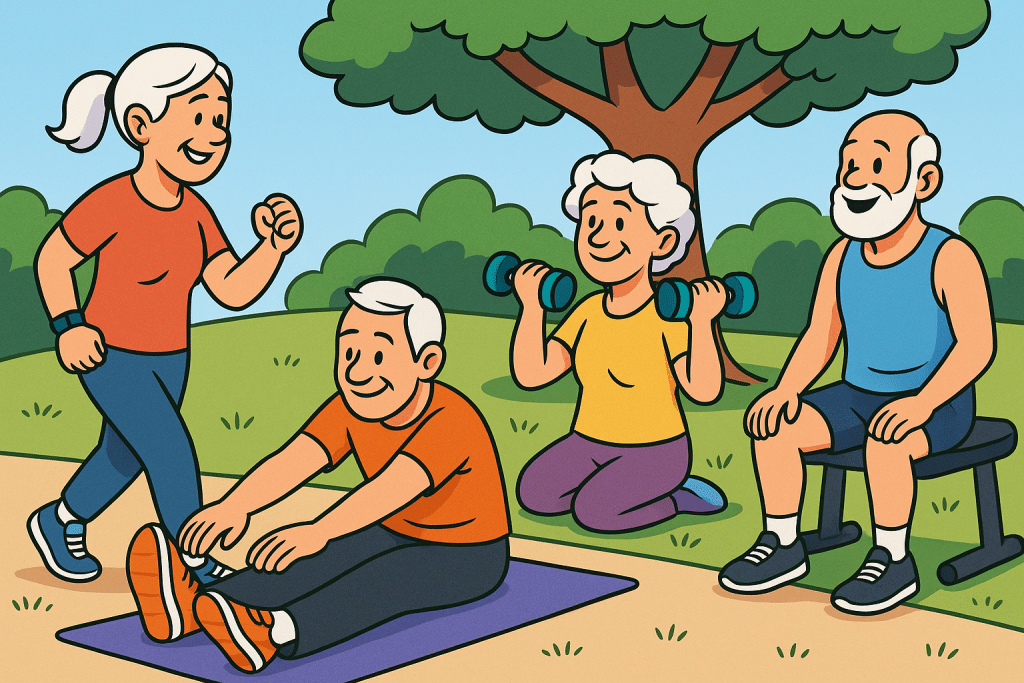
Why Fitness Matters More As We Age
As the body ages, muscle mass declines (a process called sarcopenia), bones lose density, and balance weakens, raising risks of falls and fractures. Exercise plays a key role in slowing these processes. The Centers for Disease Control and Prevention (CDC) notes that just 150 minutes of moderate activity per week can significantly reduce the risk of chronic disease and mobility loss (CDC 2022).
But beyond preventing decline, new studies highlight that certain fitness routines can actually reverse biological aging markers, making them a hot topic in both medical and wellness communities.
The Rise of Functional Fitness for Healthy Aging
One of the most important trends today is functional fitness—workouts that mimic everyday movements to improve balance, coordination, and strength. Think squats (for sitting and standing), lunges (for climbing stairs), or carrying weights (to mirror grocery bags).
A study in the Journal of Aging Research found that older adults who practiced functional exercises three times a week saw measurable improvements in gait speed, mobility, and fall prevention compared to traditional exercise programs (Liu and Latham 2020).
Why it matters: Functional fitness doesn’t just build muscle—it helps maintain independence, allowing older adults to keep performing daily activities safely.
Strength Training: The Anti-Aging Secret Weapon
Strength training isn’t just for athletes—it’s now considered essential for older adults. According to Harvard Health, lifting weights or doing resistance band workouts increases bone density and muscle strength, directly combating osteoporosis and frailty (Harvard Health 2021).
Emerging research even links strength training to slower cellular aging, with resistance exercise shown to boost mitochondrial function, a key indicator of how the body ages on a biological level (Konopka and Harber 2014).
Best practices for aging adults:
- Train 2–3 times per week
- Focus on compound moves like squats, push-ups, rows, and overhead presses
- Use progressive overload—gradually increase resistance to stimulate adaptation
Brain-Body Fitness: The Cognitive Edge
Cognitive decline is one of the greatest concerns with aging. That’s why fitness routines combining physical movement with mental challenges are gaining popularity. Practices like tai chi, dance classes, and even “exergames” (video games that require movement) are now backed by science for protecting brain health.
A large meta-analysis in Frontiers in Aging Neuroscience showed that older adults who engaged in dual-task training (physical + cognitive exercises) had significantly better memory and executive function than those doing standard workouts (Zhu et al. 2022).
Example routines include:
- Learning new dance steps (movement + memory)
- Tai chi (movement + mindfulness)
- Interactive VR fitness games (movement + reaction speed)
Aerobic Exercise: Still King for Longevity
While strength and brain-body training are trending, aerobic exercise remains critical. Activities like brisk walking, cycling, or swimming boost cardiovascular health, which in turn lowers risks of dementia, diabetes, and heart disease.
A study published in Circulation found that adults who maintained regular aerobic activity had a 35% lower risk of all-cause mortality compared to sedentary peers (Arem et al. 2015).
Tip: Older adults should aim for 30 minutes of walking five days a week—but even shorter bouts of 10 minutes, spread throughout the day, still provide benefits.
The Power of Low-Impact Routines
For seniors with joint issues or chronic conditions, low-impact exercise is revolutionizing fitness accessibility. Water aerobics, Pilates, and chair yoga are being recognized for their ability to strengthen muscles and improve flexibility without stressing the joints.
Chair yoga in particular is emerging as a strong trend. A 2021 study showed that seniors practicing chair yoga twice weekly for 8 weeks had significant reductions in pain and fatigue associated with osteoarthritis (Park et al. 2021).
Hot Trend: Longevity Gyms and Tech-Driven Workouts
Tech-driven fitness solutions are making waves in the healthy aging space. “Longevity gyms,” which blend biofeedback devices, resistance machines, and recovery tools, are springing up globally. These gyms are designed for 50+ populations looking to build resilience and track progress with data.
Wearables and smart fitness devices now monitor not just steps but also heart rate variability, sleep quality, and recovery—all biomarkers of aging. This personalized feedback allows older adults to train smarter, not harder.
Putting It All Together: A Weekly Routine for Healthy Aging
A well-rounded week balances strength, cardio, mobility, and recovery. Mixing them up keeps your body challenged and helps you avoid burnout. Here’s a sample plan:
- Monday – Strength training (45 min full-body): Start the week by building muscle and protecting bone density. Use weights, resistance bands, or bodyweight moves like squats and push-ups.
- Tuesday – Brisk walk or cycling (30–40 min): Cardio to strengthen your heart and lungs. Outdoors if possible for fresh air and vitamin D.
- Wednesday – Functional fitness or tai chi: Focus on balance, coordination, and everyday movement. Tai chi doubles as a calming practice for stress.
- Thursday – Strength training (compound lifts): Multi-joint exercises like rows or lunges target multiple muscles at once, improving both strength and efficiency.
- Friday – Dance or exergames (45 min): End the workweek with something fun. Dancing sharpens memory and coordination, while exergames bring a playful twist to fitness.
- Saturday – Chair yoga or Pilates: Gentle flexibility and core work to keep joints mobile and posture strong. Great for reducing stiffness from the week.
- Sunday – Rest or light stretching: Use this as an intentional recovery day. Light walks or stretching keep you moving without overloading your body.
This mix touches every area that matters for aging well: strength for independence, cardio for endurance, balance for safety, and flexibility for mobility.
Conclusion
Aging doesn’t mean slowing down—it means training smarter. From strength training to functional movement and brain-body workouts, the latest science shows that fitness routines designed for older adults don’t just preserve health, they enhance it. By adopting these trends, we’re not just adding years to life—we’re adding life to years.
References
- World Health Organization (2020) Physical activity and older adults. Available at: https://www.who.int (Accessed: 26 September 2025).
- National Institute on Aging (2021) Exercise and physical activity: Your everyday guide from the National Institute on Aging. Available at: https://www.nia.nih.gov (Accessed: 26 September 2025).
- American Heart Association (2022) Benefits of physical activity for aging adults. Available at: https://www.heart.org/en (Accessed: 26 September 2025).

 Interior Organization Tips That Save Time and Effort