Interior Organization Solutions That Maximize Space
Giulia Bianchi October 1, 2025
In 2025, interior organization solutions that maximize space are gaining real traction as people face tighter city footprints, remote work demands, and the surge of micro-living. This article explores the most compelling trends and tactics redefining how we store, live, and thrive in compact interiors.
Why maximizing space is the new battleground
As urban populations densify and housing becomes more expensive, every square foot matters. According to data on microapartments, these units often use foldable furniture, hidden storage, and multifunctional systems to pack in all the essentials into 14–32 m² units.
Meanwhile, home organization experts highlight that organization is not just about tidying – it’s increasingly seen as a form of self-care, and people want solutions that feel clean, intuitive, and seamless in daily life.
So the threshold is rising: it’s no longer enough to shove things behind closed doors. Modern interior organization solutions that maximize space must be smart, stylish, and often tech-enabled.
5 Emerging Trends in Storage & Organization for 2025
1. Robotic and transformable furniture systems
The idea of “furniture that moves for you” has been around for a bit, but it’s now becoming more feasible and aesthetic. MIT’s Ori system (a modular wall unit with actuated panels) allowed beds, desks, and storage to shift seamlessly via app or control panel.
Though Ori isn’t yet mainstream, variants and smarter modular systems are filtering into niche luxury homes and prototypes. As actuators, smart materials, and compact motors become cheaper, transformable furniture will be a key pillar of interior organization solutions that maximize space.
2. The “Everything Closet” concept
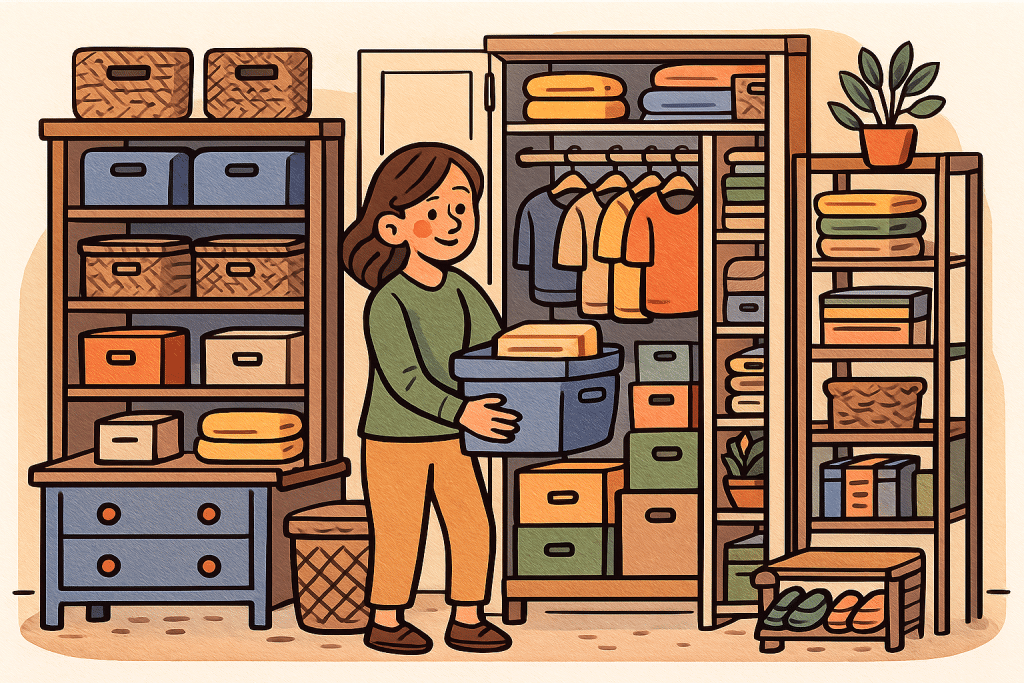
One of the rising trends in 2025 is the “Everything Closet”—a multipurpose hub near an entry or utility area that holds coats, shoes, cleaning supplies, pet gear, seasonal items, and more. Rather than scattering storage zones across the home, this consolidates and subdivides in one well-designed space.
Key principles:
- Use adjustable shelving and drawer modules
- Integrate wall hooks, pegboards, or magnetic strips
- Place heavier items low, lighter ones high
- Treat visual organization (labels, bins) as part of the aesthetics
The Everything Closet epitomizes how interior organization solutions that maximize space can simplify routines and reduce clutter in multiple rooms.
3. Vertical layering and built-in architecture
Rather than focusing only on the floor plan, designers are extending storage upward—into walls, ceilings, and structural elements. Anne Hathaway’s home made waves for using vertical shelving integrated into exposed ceiling beams, transforming what would otherwise be “dead” space into functional display and storage zones.
Built-ins that hug corners, recess into walls, or rise in stepped layers allow for “airier” layouts without sacrificing capacity. This is a powerful tactic in interior organization solutions that maximize space when square footage is fixed but height remains underutilized.
4. Intentional, sustainable organizing
In 2025 organizers emphasize intentionality: using durable, sustainable materials, buying less but better, and giving emotional (not just functional) value to storage systems.
For example:
- Bamboo drawer dividers
- Recycled-plastic modular baskets
- Fabric bins that don’t scratch surfaces
- Upcycling existing furniture by retrofitting internal dividers
The idea is that your storage should last—and resonate—rather than be disposable or styled purely for show. That philosophy becomes core to interior organization solutions that maximize space in a sustainable era.
5. Integration of digital, sensor, and AI systems
Home tech is creeping into storage. Imagine closets that track which items you use, suggest reorganizing based on season, or even logs what’s missing. In 2025, organizers forecast more use of tech tools (apps, sensors, AI) to manage space and routines.
In commercial storage and warehouses, AI and reinforcement learning are already being applied to optimize retrievals in multi-deep storage racks. While homes are far simpler, the direction points toward smarter algorithms guiding how we store in tight spaces.
Blending such tech with modular furniture or transformable surfaces is one of the next frontiers in interior organization solutions that maximize space.
How to Apply These Trends: A Practical Guide
Here’s a step-by-step playbook you can adapt to your own home:
1: Audit and zone
- Walk through each room and note every storage zone (closet, under the bed, cabinet, wall)
- Which zones are underused or cluttered?
- Assign each zone a “function” (e.g. daily use, seasonal, tools, hobby, paperwork)
This audit gives clarity on where interior organization solutions that maximize space will have the biggest impact.
2: Prioritize vertical + hidden opportunities
- Look up: above doors, over windows, along vertical walls
- Consider built-in shelving, recessing cabinets, or hidden compartments
- Identify areas where transformable furniture (murphy beds, fold-down desks) can replace static pieces
3: Choose modular and adjustable systems
- Start with a backbone: an adjustable shelving frame, track system, or base cabinet
- Add modular inserts: dividers, bins, sliding trays, hooks
- Use a unified aesthetic so organization feels cohesive, not piecemeal
4: Incorporate smart or reactive elements
- Use motion sensors or LED strips to light up interiors
- Try sensor-based inventory apps (e.g. what’s in your pantry)
- For bigger budgets: explore motorized or transformable units that shift on demand
5: Test, iterate, and reduce
- Live with your system for a few weeks
- Notice pain points (items hard to reach, bins underused)
- Adjust shelves/dividers accordingly
- Declutter ruthlessly (less stuff = less need to squeeze)
Example Use Cases: Micro-apartments, Family Homes, Hybrid Spaces
Micro-apartments / studios
These spaces demand interior organization solutions that maximize space by combining functions. A kitchen island might fold into a work desk; a seating bench may hide a bed inside; a wardrobe may fold down into storage. Many micro units already use these tactics.
Family homes
Here the goal is zones + flexibility. For example, the Everything Closet may serve as a home command center. Kids’ rooms adopt adjustable walls and toy storage that adjusts with age. Garages and utility rooms get sensor lighting and smart racks.
Hybrid work/living
In homes with a workspace, organization solutions might need to convert between “office mode” and “living mode.” For example, a desk folds away, shelves slide to conceal, and storage cubes become room dividers.
Challenges & Tips to Avoid Pitfalls
- Budget creep: Smart systems are fun to plan, but start with core modular tracks and build over time
- Overengineering: Don’t build transformable systems you’ll never use. Simpler is better if used
- Access vs. capacity tradeoff: Too much dense stacking can make retrieving things a chore. Use pull-out trays and accessible fronts
- Style coordination: Storage shouldn’t feel like an add-on. Match colors, materials, finishes so organization feels integrated
- Maintenance: Even the best system fails if you don’t keep up—for instance, declutter annually, adjust labels, re-audit zones
The Future: What’s Next for Maximal Space Organization?
Looking ahead, I foresee:
- Wider adoption of smart furniture that senses usage and reconfigures automatically
- AI design assistants that suggest storage layouts given your inventory (e.g. DecoMind, an AI system to generate interior layouts)
- Material innovations: ultralight, shape-shifting panels or fabrics that can morph into partial walls or drawers
- Augmented reality (AR) toolkits that project where you should place storage units in your room
- Community/shared storage networks (especially in dense urban settings) where adjacent units share compartmentalized systems
These point toward a future in which interior organization solutions that maximize space shift from static furniture to dynamic, context-aware systems.
Closing Thoughts
Finding more room in your home is no longer about piling boxes or installing generic shelving. The vanguard of interior organization solutions that maximize space combines modular design, vertical thinking, sustainable choices, and emerging tech. Whether you’re in a micro-apartment or a family home, the key is deliberate layering, flexibility, and continuous adaptation.
Start small: audit your storage, identify a zone to optimize, pick a modular backbone, and see how it changes your daily flow. Over time, these accumulated improvements yield a home that’s calmer, more spacious, and truly responsive to your life.
References
- Better Homes & Gardens (2025) ‘5 Home Organizing Trends Experts Want You to Use in 2025’. Available at: https://www.bhg.com/organizing-trend-predictions-2025-8765465
- LivingEtc (2025) ‘7 Home Organization Trends for 2025 That Will Help Keep Your Home Uncluttered’. Available at: https://www.livingetc.com/advice/home-organization-trends
- Organized Living (2025) ‘Bringing 2025’s Top Design Trends to Closet and Storage Solutions’. Available at: https://organizedliving.com/dealers/news/bringing-2025-s-top-design-trends-to-closet-and-storage-solutions

 Fitness Routines That Support Healthy Aging